Science & Agriculture · April 2026
Kalpakkam’s Nuclear Dawn:
Powering India’s Agricultural Future
How Tamil Nadu’s historic fast breeder reactor — fuelled by thorium and uranium — is set to transform the way India grows its food.
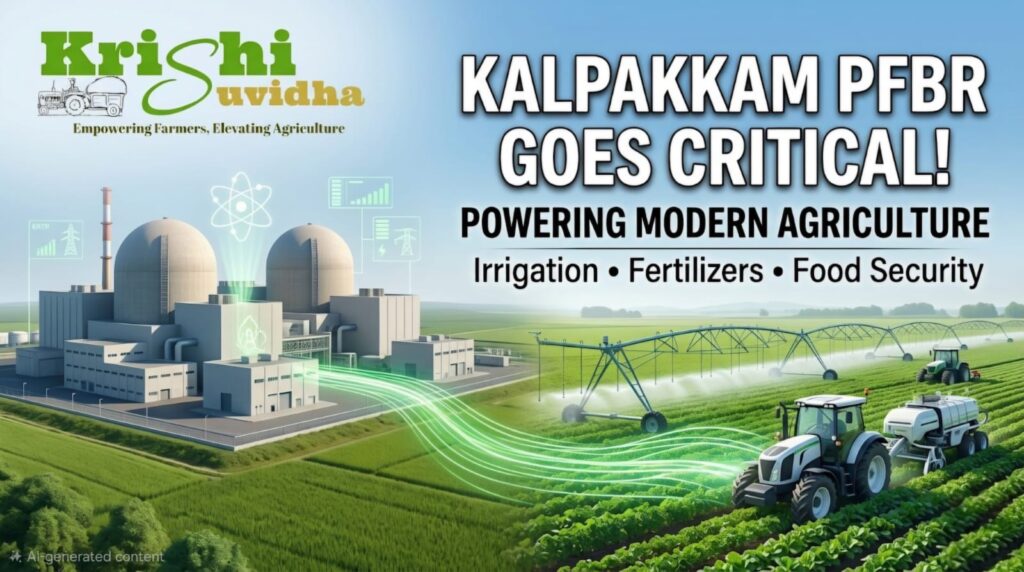
On the evening of 6 April 2026, at 8:25 PM IST, a quiet coastal town near Chennai made history for the entire world. The Prototype Fast Breeder Reactor (PFBR) at Kalpakkam, Tamil Nadu, achieved its first criticality — the moment a self-sustaining nuclear chain reaction begins — marking India’s bold entry into the second stage of its legendary three-stage nuclear power programme. Built entirely by Indian scientists and engineers at Bharatiya Nabhikiya Vidyut Nigam Limited (BHAVINI), the 500 MWe reactor is not merely a power plant. It is the key to unlocking India’s nuclear-powered agricultural revolution.
Prime Minister Narendra Modi called it “a defining step,” reflecting the depth of India’s scientific capability. With this single achievement, India became only the second country in the world — after Russia — to operate a commercial fast breeder reactor. But the true significance of Kalpakkam goes far beyond energy. It is the engine that will soon power millions of irrigation pumps, cold storage chains, fertiliser plants, and precision farming networks across the country.
The Fuel Behind the Fire: Uranium & Thorium
India has a fundamental energy paradox: it holds only 1–2% of the world’s uranium reserves, yet imports large quantities of uranium to fuel its existing reactors. But nature has given India a remarkable gift — nearly 25% of the world’s thorium reserves, found in the monazite sands of Kerala, Odisha, and coastal Tamil Nadu itself. The PFBR at Kalpakkam is specifically engineered to bridge these two realities.
“One tonne of thorium can produce as much energy as 200 tonnes of uranium — and India sits on one of the world’s largest thorium deposits.”
The reactor uses Uranium-Plutonium Mixed Oxide (MOX) fuel at its core, surrounded by a fertile blanket of Uranium-238. Fast neutrons convert this Uranium-238 into Plutonium-239, producing more fuel than the reactor actually burns. In a revolutionary design feature, the blanket also incorporates Thorium-232. Through a process called transmutation, the thorium is converted into Uranium-233 — the clean, powerful fuel that will drive India’s third and final stage of nuclear power: the thorium era. In effect, the Kalpakkam plant is an “Akshay Patra” of energy — a self-replenishing vessel that never runs dry.
- Capacity: 500 MWe electrical output
- Reactor type: Sodium-cooled fast breeder
- Fuel: Uranium-Plutonium MOX
- Blanket: Uranium-238 & Thorium-232
- Breeds more fuel than it consumes
- Operational life: 40 years
- Developer: IGCAR / BHAVINI (100% indigenous)
- Grid connection: Expected by Sept 2026
India’s Three-Stage Nuclear Vision
The genius of India’s nuclear strategy — first conceived by Dr. Homi Jehangir Bhabha — lies in its elegant chain of stages, each feeding the next until thorium powers the nation for potentially a thousand years.
From the Reactor to the Farmer’s Field
The connection between nuclear energy and modern agriculture may not be immediately obvious, but it is profound. Indian farming is one of the world’s largest consumers of electricity — powering over 20 million irrigation pumps alone. Frequent power shortages force farmers to rely on expensive, polluting diesel generators. Cheap, abundant, round-the-clock nuclear power from Kalpakkam and future reactors will change this permanently.
Abundant electricity enables precision agriculture at scale: sensor-driven drip irrigation, automated greenhouses, AI-powered soil monitoring, and climate-controlled cold storage that currently loses nearly 30% of India’s fruits and vegetables to spoilage each year. Reliable power also transforms the fertiliser industry. The production of nitrogenous fertilisers — urea in particular — is extremely energy-intensive. With nuclear energy cutting electricity costs for fertiliser plants, Indian farmers gain access to more affordable crop nutrition, directly reducing input costs and boosting margins. Furthermore, nuclear technology directly supports agriculture through radiation-induced crop improvement — a technique already used by India’s Bhabha Atomic Research Centre (BARC) to develop over 50 high-yield, drought-resistant crop varieties. The expanded nuclear programme will accelerate this research significantly.
A Self-Reliant Energy Future
The SHANTI Act of 2025 — the Sustainable Harnessing and Advancement of Nuclear Energy for Transforming India Act — further strengthens this vision by modernising India’s nuclear legal framework and enabling measured private sector participation. With a national target of 100 GW of nuclear power by 2047, the Kalpakkam breakthrough is the first domino in a cascade that will reshape India’s energy landscape and, with it, the lives of its 600 million farmers. India’s thorium reserves, experts estimate, could sustain nearly 500 GW of clean electricity for over 400 years — a millennium of energy security rooted not in imports, but in India’s own ancient monazite sands. From Tamil Nadu’s coastline, the atomic age of Indian agriculture has quietly, brilliantly, begun.