
General Information

Carrots are root vegetables rich in nutrients and unique qualities. The edible part is a modified conical root, and it contains malic acid as the main organic acid. The orange-colored types are especially valued as they are rich in carotene, thiamine, and riboflavin. The taste of carrots is mainly attributed to glutamic acid, while caffeic acid is the predominant phenolic compound. Apart from this, pink and black-colored carrots contain anthocyanins, which add to their nutritional and medicinal value. A traditional beverage called kanji, known as an appetizer, is prepared from black carrots. Carrot fruits are of the schizocarpic type. The major carrot-producing states in India are Haryana, Punjab, Madhya Pradesh, Bihar, and Maharashtra.
Climate
Carrot is essentially a cool season crop. The Optimum temperature for seed germination is 7.5-23.5 degree centigrade and 18-22 degree centigrade for best root growth and development whereas 15-21 degree centigrade for colour development.
| Temperature | Rainfall | Sowing Temperature | Harvesting Temperature |
| 18.3 °C – 21°C | 500 mm | 10 °C – 22 °C | 15°C- 21 °C |
Soil
It requires deep well drained sandy loam. This type of soil is particularly good for early crop. Heavy soils will check the development of roots and cause forked lateral roots. It is grown in rainy season under heavy soil condition or black soil condition even then it will produce abnormal or forked roots. Roots impeded by rich soil strengthened or thickened with increased branching. Carrots do not grow will highly acidic soil. Maximum yield can be obtained at pH of 6.5
Varieties
Pusa Kesar
Pusa Kesar, yields around 30 t/ha (300 q/ha) under North Indian conditions. It produces deep-red, tapering roots rich in carotene and resists bolting for an extra month compared to local types. The variety matures in about 80–110 days and is well suited for both fresh consumption and processing. A notable feature of this variety, so that the root stay a month longer in without any sign of bolting.
Pusa Meghali
Pusa Meghali yields approximately 25–30 t/ha and matures in 110–120 days. It features smooth, orange-fleshed roots with a self-coloured core and is versatile for early (Aug–Sept) or late (Oct–Nov) sowings. This makes it adaptable across diverse cropping seasons.
Selection No. 233
Selection 233, developed by PAU Ludhiana, delivers an average yield of 35 t/ha. It produces smooth, semi-cylindrical roots (~15.5 cm) that are light orange with uniform cores, and are notably resistant to cracking and forking—ideal for distant markets
Selection 21
Selection 21 generates smooth, deep-orange cylindrical roots with a semi-blunt end and uniform core. Though exact yield figures aren’t specified in the references, this variety is prized for its high yield potential, nutritional quality (11% TSS, 6.45 mg/100 g carotene), and excellent suitability for candy, pickles, and spiced juice products
Pusa Yamdagini
Pusa Yamdagini is European or Temperate type of carrot which yields around 20–25 t/ha and reaches maturity in about 90–100 days. It features slightly tapering orange roots (15–16 cm length), with self-coloured cores, and is well adapted to plains and tropical regions.
Danvers
The Danvers variety, a widely recognized foreign / European or Temperate type, produces conical roots with well-defined shoulders and is highly adaptable to various soils. Though specific yield data in India isn’t available, Danvers is valued for its sturdiness, good storage ability, and suitability for both fresh consumption and processing.
Nantes Half Long
A European temperate variety, Nantes Half Long features cylindrical, stumpy roots with an abrupt tail, sweet and fine-grained orange flesh, and a small self-coloured core. It matures in 90–110 days and yields 15–20 t/ha.
Early Nantes
This early-maturing European type produces almost cylindrical roots with small thin tails, 12–15 cm long, and an evenly pigmented core. It matures in 90–100 days.
Chantenay
Chantenay is valued for canning and storage, featuring deep reddish-orange roots of 11.5–15 cm length and tapering to a blunt end. It matures in 100–120 days with yields of around 15–150 q/ha (15–15 t/ha) depending on the source.
Imperator
A cross between Nantes and Chantenay, Imperator has long (15–17.5 cm), deep-orange tapering roots with a small fibrous core. It matures later (120–130 days) and yields 120–150 q/ha (12–15 t/ha).
Zeno
Introduced from Germany and popular in the Nilgiris (Ooty region), Zeno carrots have deep-orange, 15–17 cm roots that are slightly tapering. They mature in 110–120 days and are known for high yield and excellent quality.
Ooty-1
This temperate-type variety produces deep-orange roots with self-coloured cores. It matures in 100–110 days.
Land Preparation
The land should be thoroughly ploughed to achieve a fine tilth, ensuring the soil becomes loose and friable, with all clods completely removed. At the time of final ploughing, apply well-decomposed farmyard manure (FYM) at 20–25 tonnes per hectare to enrich the soil. After this, the field is prepared into flat beds or laid out in ridges and furrows for sowing.

Sowing
Sowing Time
Carrot can be sown during June–July, August, and September in the plains, while in hilly regions, sowing is done during January–February. The tropical types are sown up to September to October, whereas the temperate types are taken up from August to November i.e, it can grown throughout the year.
Sowing depth
Seeds are sown to a depth of 2 to 2.5 cm
Spacing
The spacing should be 25 x 8 cm or 30 x 10 cm
Method of sowing
Carrot seeds are sown directly in the main field, either on flat beds or on ridges and furrows depending on the season and soil condition. During the rainy season, ridges and furrows are preferred to avoid waterlogging, while in the Rabi season, sowing is done on flat beds if the soil is loose and friable. However, in heavier or harder soils, ridges and furrows are recommended as they provide better root development, good drainage, and ease of intercultural operations. This practice also helps in obtaining uniform and healthy roots.
Seed rate
About 8-10 kg seeds is sufficient to grow in one hectare.
Fertilizer
Nutrient Requirement (kg per hectare)
| NITROGEN | PHOSPHORUS | POTASH |
| 120 | 60 | 60 kg |
Fertilizer Requirement (kg per hectare)
| UREA | SSP | MOP |
| 261 | 375 | 100 |
Note
It is recommended as basal dosage.
Excess nitrogen reduces root quality damage the content of sugar, dry matter, carotene and vitamin C.
Fresh cowdung should not be applied it may cause forking of roots.
Nutrient Deficiency
Boron Deficiency
Symptoms
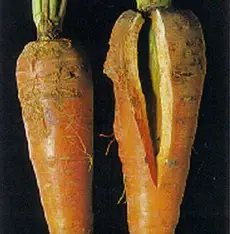
In carrots, boron deficiency leads to distinct root deformities. The roots develop black or brown patches inside, known as “brown heart”, and in severe cases become cracked, hollow, or spongy. The outer surface may also show roughness or splitting, while the inner tissues break down, making roots unfit for storage and consumption. Leaves may appear distorted, brittle, and easily broken, and overall plant growth becomes weak and uneven.
Management
Apply Borax @ 8–10 kg/ha as basal dose in the soil. Foliar sprays of 0.2% Borax (2 g/litre of water) or 0.1% Solubor (1 g/litre) at 30 and 45 days after sowing help correct the deficiency and prevent recurrence, especially in sandy soils.
Weed Control
Usually, two hand weedings at 15–20 days and again at 30–35 days after sowing are enough to manage weeds in carrot fields. For chemical control, pre-emergence application of Fluchloralin or Trifluralin @ 0.5–1.0 kg/ha, and Pendimethalin @ 1.0 kg/ha as post-emergence, are found to be effective in keeping the field weed-free.
Intercultural Operations
Thinning is a crucial practice in carrot cultivation since seeds are very small and sown thickly. This operation is carried out 20–30 days after sowing to adjust spacing and ensure a proper 10 cm distance between plants, which helps in healthy root development.

Earthing up
This practice is carried out 60–70 days after sowing to support proper root development. Soil is heaped around the plants to cover the exposed portion of roots, which prevents the tops from turning green and toxic due to sunlight exposure.
Mulching
The field is mulched using soybean stubbles or rye mulch, which has been found more effective compared to conventional tillage in conserving soil moisture and improving crop growth.
Irrigation
Irrigate the crop once in 6-7 days after sowing depending upon the rain and weather condition.
Physiological disorders
Carrot Splitting
This is a serious physiological disorder in which carrot roots develop cracks. While genetics play a role, several external factors also contribute, such as heavy application of nitrogenous fertilizers at early stages, low chloride levels in soil, wide plant spacing, large root size, and fluctuations in soil moisture.
Management:
Use resistant varieties, maintain closer spacing, apply nitrogen in the recommended dose, ensure proper soil moisture, and harvest at the correct maturity stage.
Cavity Spot
This disorder is marked by the development of cavities in the root cortex, often accompanied by the collapse of the epidermis, resulting in pitted lesions. It is mainly associated with calcium deficiency, excessive potassium levels, and delayed harvesting.

Management
Apply calcium-based fertilizers to the soil and harvest the crop at the proper time to avoid the disorder.
Plant Protection
Major Insect – Pest and their management
| Pest/Insect Name | Symptoms | Peak Infestation Time | Management |
| Carrot Rust Fly | Maggots feed on roots, creating tunnels; roots become deformed, discoloured, and unmarketable. | Seedling to root development stage | Practice crop rotation, avoid continuous carrot cropping, use protective netting, apply insecticides like Chlorpyriphos 0.05% if infestation is severe. |
| Aphids | Colonies suck sap from tender shoots and leaves; plants become stunted, leaves curl, and growth is checked. | Vegetative stage | Spray systemic insecticides like Dimethoate 0.05% or Rogor 0.05%; natural predators like ladybird beetles can also be conserved. |
| Cutworms | Caterpillars cut seedlings at the ground level and feed on leaves and tender stems. | Seedling and early growth stage | Apply Malathion dust @ 25 kg/ha or spray 0.15% Malathion solution; deep ploughing before sowing destroys pupae. |
| Armyworms | Caterpillars feed voraciously on foliage, leaving only veins; can defoliate entire plants if severe. | Vegetative to early root formation stage | Spray Carbaryl 0.2% or Lambda-cyhalothrin 0.005%; hand-picking of larvae at early stage helps. |
| Nematodes (Root-knot) | Formation of knots/galls on roots, stunted plant growth, yellowing of leaves, and poor yield. | Root development stage | Apply Carbofuran 1 kg a.i./ha or neem cake in soil; practice crop rotation with cereals. |
Carrot Rust Fly
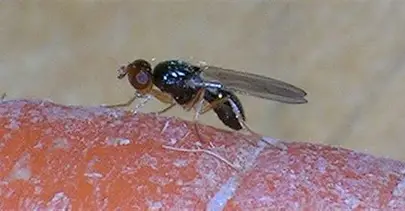
The carrot rust fly is a major pest where the maggots bore into the roots, creating tunnels. This leads to discolored, deformed, and unmarketable roots. Infestation generally occurs from the seedling stage to root development.
Management
Crop rotation should be practiced and continuous carrot cropping must be avoided. In case of heavy infestation, spraying with Chlorpyriphos 0.05% is effective, and protective netting can also reduce the pest attack.
Aphids
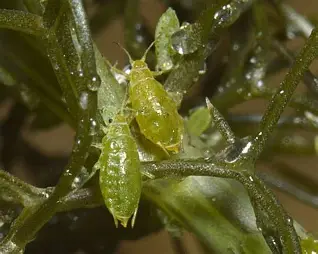
Aphids form dense colonies on the leaves and young shoots, sucking plant sap. This causes the plants to become weak, stunted, and results in curling of leaves and poor vigor. The problem is most severe during the vegetative stage.
Management
Spraying systemic insecticides like Dimethoate 0.05% or Rogor 0.05% helps in controlling aphids. Conservation of natural enemies such as ladybird beetles is also effective in reducing their population.
Cutworms
Cutworms attack seedlings by biting and cutting the stems at ground level. They also feed on tender leaves, resulting in plant death. Damage is most severe during the seedling and early plant growth stage.

Management Deep ploughing before sowing helps in destroying pupae. For control, Malathion dust @ 25 kg/ha or spraying 0.15% Malathion solution is recommended.
Armyworms
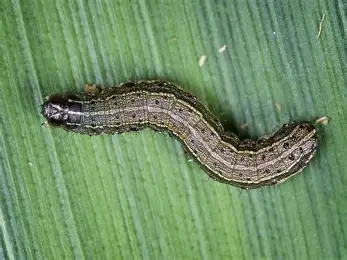
Armyworms are voracious feeders and they damage carrot foliage by consuming leaves from the margins to the center. In severe cases, only the leaf veins remain, and sometimes plants are completely defoliated. This attack occurs from the vegetative stage to early root formation.
Management Early-stage larvae can be hand-picked to reduce damage. For chemical control, Carbaryl 0.2% or Lambda-cyhalothrin 0.005% spray is effective.
Root-knot Nematodes
Root-knot nematodes cause knot-like swellings or galls on carrot roots, which leads to poor nutrient absorption. This results in stunted growth, yellowing of leaves, and reduced yield. The damage is most evident during the root development stage.
Management
Application of Carbofuran 1 kg a.i./ha in the soil or neem cake at sowing helps reduce nematode population. Crop rotation with cereals is also effective in breaking the nematode cycle.

Major Diseases and their management
| Disease Name | Symptoms | Peak Infestation Time | Management |
| Alternaria Leaf Blight | Dark brown to black spots with yellow margins on older leaves; leaves dry prematurely, reducing root yield. | Late vegetative to root development stage. | Spray Mancozeb @ 2.5 g/litre of water or Chlorothalonil @ 2 g/litre of water at 10–15 day intervals. Remove infected leaves. |
| Powdery Mildew | White, powdery growth on leaves, leading to yellowing and drying. | Vegetative to maturitry stage. | Spray Karathane (Dinocap) @ 0.5 ml/litre of water or dust Sulphur @ 25 kg/ha on foliage. |
| Downy Mildew | Yellow angular spots on upper leaf surface with whitish downy growth on the underside. | Early growth stage. | Spray Metalaxyl + Mancozeb (Ridomil MZ) @ 2.5 g/litre of water at 10-day intervals. Maintain spacing to reduce humidity. |
| Cercospora Leaf Spot | Small, round brown lesions that enlarge, causing blight. | Vegetative stage | Spray Carbendazim @ 1 g/litre of water or Mancozeb @ 2.5 g/litre of water alternately. |
| Sclerotinia Rot (White Mold) | White cottony growth with black sclerotia on crown and roots, leading to rot. | Root development and storage. | Drench soil with Carbendazim @ 1 g/litre of water around root zone. Improve drainage to avoid waterlogging. |
| Bacterial Soft Rot | Watery, soft decay of roots with foul smell; tissues turn slimy. | High soil moisture, mechanical injury, poor post-harvest handling. | Treat harvested roots with Chlorinated water (100–150 ppm); improve drainage and avoid injuries during harvest. |
| Aster Yellows (Phytoplasma) | Yellowing, stunting, hairy roots (“witches broom”). | Early Vegetative to root initiation stage. | Spray Imidacloprid @ 0.5 ml/litre of water to control leafhoppers. Rogue out infected plants. |
Alternaria Leaf Blight
Alternaria leaf blight appears as dark brown to black spots with yellow margins on older leaves. These spots gradually enlarge, causing the leaves to dry up prematurely, which directly reduces root yield.

Management:
Spray Mancozeb @ 2.5 g per litre of water or Chlorothalonil @ 2 g per litre of water at intervals of 10–15 days. In addition, infected leaves should be removed from the field to reduce disease spread.
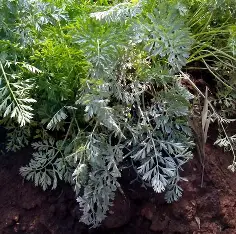
Powdery Mildew
Powdery mildew is recognized by its characteristic white, powdery fungal growth on the leaves, which later leads to yellowing and drying of the foliage. This disease thrives in dry conditions combined with high humidity.
Management:
Spray Karathane (Dinocap) @ 0.5 ml per litre of water or dust Sulphur @ 25 kg per hectare over the foliage to effectively control the disease.
Downy Mildew
Downy mildew produces yellow angular spots on the upper leaf surface with a whitish, downy growth underneath. This disease favours cool, moist conditions.

Management:
Apply a foliar spray of Metalaxyl + Mancozeb (Ridomil MZ) @ 2.5 g per litre of water at 10-day intervals. Maintaining adequate spacing in the field also helps to reduce humidity and prevent the spread.
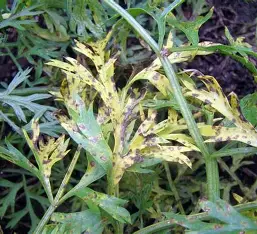
Cercospora Leaf Spot
Cercospora leaf spot begins as small, round brown lesions on the leaves that gradually enlarge, leading to blight and eventual leaf death. It is more prevalent in warm, moist conditions.
Management:
Spray Carbendazim @ 1 g per litre of water or Mancozeb @ 2.5 g per litre of water, applying them alternately to prevent resistance build-up in the pathogen.
Sclerotinia Rot
Sclerotinia rot, also called white mold, is seen as white cottony fungal growth with black sclerotia forming on the crown and roots, which eventually leads to rotting. The disease occurs in fields with high soil moisture and cooler weather.

Management:
Drench the soil around the root zone with Carbendazim @ 1 g per litre of water. Proper drainage practices are also essential to prevent waterlogging, which favors this disease.
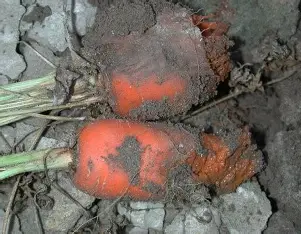
Bacterial Soft Rot
Bacterial soft rot causes watery, soft decay of carrot roots, accompanied by a foul smell. The tissues become slimy and disintegrate easily. This disease is more severe under conditions of high soil moisture.
Management:
Treat harvested roots with chlorinated water at 100–150 ppm concentration before storage. Avoid injuries to roots during harvest and ensure proper field drainage to minimize disease incidence.
Harvesting and Post Harvest Management
Early carrots are harvested when they are partly developed. For the purpose of distinct markets otherwise they are retained in the soil till they reach full maturity stage they should not be retained afterward. They have become puffy core becomes hard and is unfit for consumption. Roots become ready for harvesting in 65-85 days. The crop should be irrigated before the pulling out of roots as it facilitates easy uprooting of the roots. In Asiatic varieties, harvesting is done once the roots reach a marketable size of about 2.5 to 5 cm in diameter at the upper end. After harvest, the roots are properly trimmed and washed to ensure cleanliness before being sent to the market. Finally, they are packed in gunny bags for transportation and sale.

Yield
Tropical/Asiatic types give around 20 to 30 tonnes per ha
Temperate/Europe type may give 10 to 15 tonnes per ha
Sources