Pusa Basmati 1985: Complete Cultivation Guide for Direct Seeded Rice (DSR)
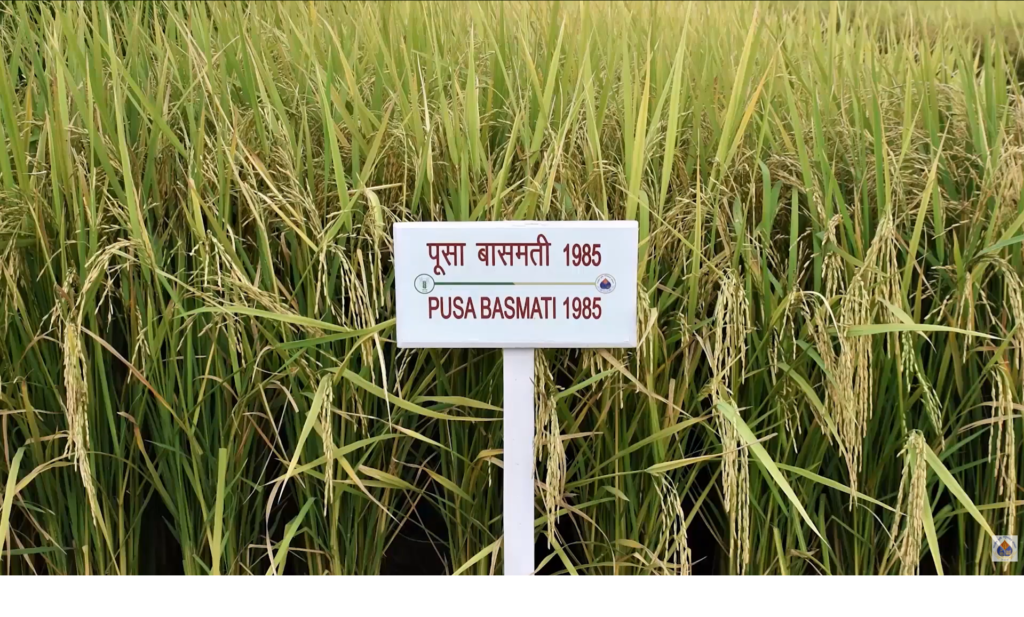
Pusa Basmati 1985 is an advanced herbicide tolerant basmati rice variety developed by the ICAR–Indian Agricultural Research Institute (IARI), New Delhi. This variety has been specifically designed to support modern rice cultivation systems, particularly Direct Seeded Rice (DSR).
The variety contains inbuilt tolerance to the herbicide Imazethapyr, allowing farmers to control weeds efficiently without harming the crop. It was developed using Marker Assisted Selection (MAS) and is genetically very similar to its parent variety Pusa Basmati 1509, maintaining the same premium grain quality and aroma.
Due to increasing labour shortages and water scarcity in major basmati-growing regions of northwestern India, farmers are gradually shifting from traditional transplanted rice cultivation to the Direct Seeded Rice system. In such conditions, weed management becomes a major challenge. Pusa Basmati 1985 addresses this issue by enabling effective herbicide-based weed control. :contentReference[oaicite:0]{index=0}
Key Features of Pusa Basmati 1985
- Herbicide tolerant basmati rice variety
- Developed using Marker Assisted Selection (MAS)
- Tolerant to Imazethapyr herbicide
- Specially suitable for Direct Seeded Rice (DSR) cultivation
- Long slender basmati grains
- Strong traditional basmati aroma
- Early maturity suitable for rice–wheat cropping system
- Average yield potential of about 4.5 – 4.6 tonnes per hectare
- Helps reduce labour requirement and cultivation costs
Grain and Cooking Quality
One of the major advantages of Pusa Basmati 1985 is that it retains the excellent grain and cooking quality characteristics of its parent variety Pusa Basmati 1509. This ensures that farmers do not compromise on market demand or export potential while adopting improved cultivation practices.
- Grain length: 8.03 mm
- Kernel length after cooking: 16.72 mm
- Amylose content: about 21.9%
- Long slender grains with very low chalkiness
- Excellent cooking elongation
- Strong basmati fragrance
Recommended Sowing Time
For achieving the best crop performance under Direct Seeded Rice systems, sowing should be carried out within the recommended window.
- Ideal sowing period: 25 May – 15 June
Sowing within this period ensures proper crop establishment, better weed control and optimum yield potential.
Herbicide Use for Weed Management
Weeds are the biggest constraint in Direct Seeded Rice cultivation because they compete with the crop for nutrients, water and sunlight. If weeds are not controlled properly, they can cause severe yield losses.
Pusa Basmati 1985 allows farmers to safely use Imazethapyr 10% SL herbicide for effective weed control.
Recommended Herbicide Dose
- Herbicide: Imazethapyr 10% SL
- Dose: 400 ml per acre
- Application stage: 2–3 leaf stage of weeds
- Application time: 18–22 days after sowing
If weed pressure remains high, a second application of the herbicide may be made within 15 days after the first spray. :contentReference[oaicite:1]{index=1}
Important Precautions for Herbicide Application
- Apply herbicide when weeds are at the 2–3 leaf stage
- Do not mix other fertilizers or chemicals with Imazethapyr
- Do not spray herbicide in flooded fields
- Avoid spraying during strong winds to prevent drift damage
- Do not irrigate fields for at least 7 days after spraying
- Avoid spraying herbicide near ponds or water bodies
- Ensure uniform spraying across the field
Following these precautions ensures effective weed control while protecting the crop from herbicide injury. :contentReference[oaicite:2]{index=2}
Advantages of Pusa Basmati 1985
- Efficient weed control in Direct Seeded Rice systems
- Reduced labour requirement for manual weeding
- Lower cost of cultivation
- Maintains premium basmati grain quality
- Early maturity allows timely wheat sowing
- Helps reduce environmental pollution caused by delayed harvesting
Conclusion
Pusa Basmati 1985 represents a significant advancement in modern basmati rice cultivation. By combining herbicide tolerance with premium grain quality, this variety provides farmers with a practical solution for efficient weed management in Direct Seeded Rice systems.
With increasing labour shortages and water limitations in rice-growing regions, varieties like Pusa Basmati 1985 can play a crucial role in improving productivity while maintaining the high-quality standards required for basmati rice markets. :contentReference[oaicite:3]{index=3}