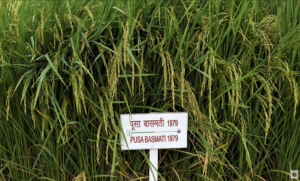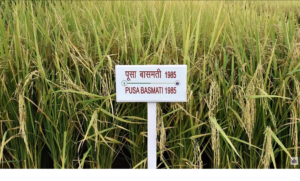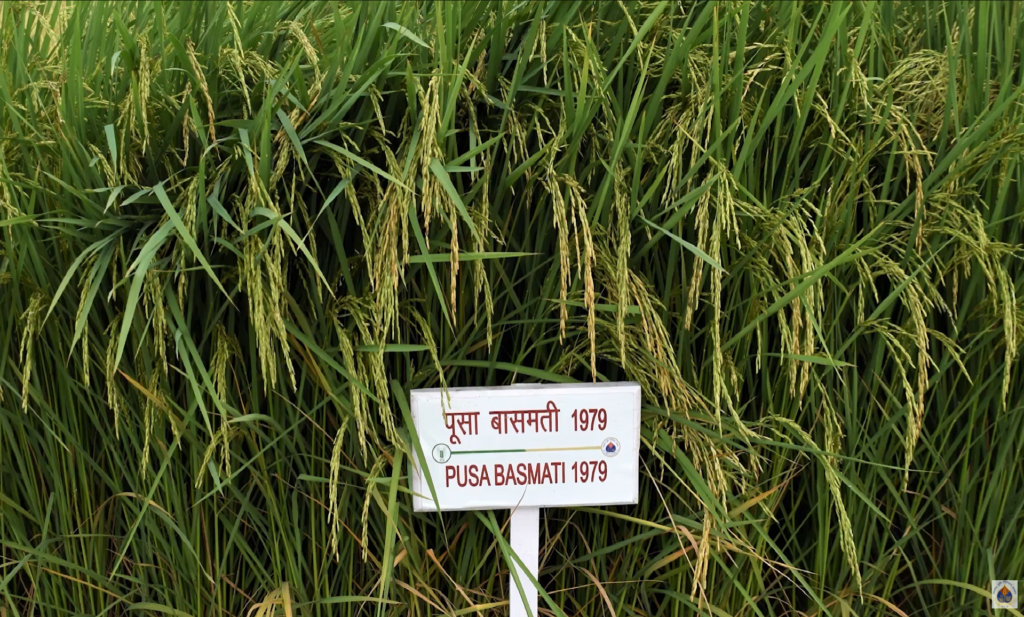
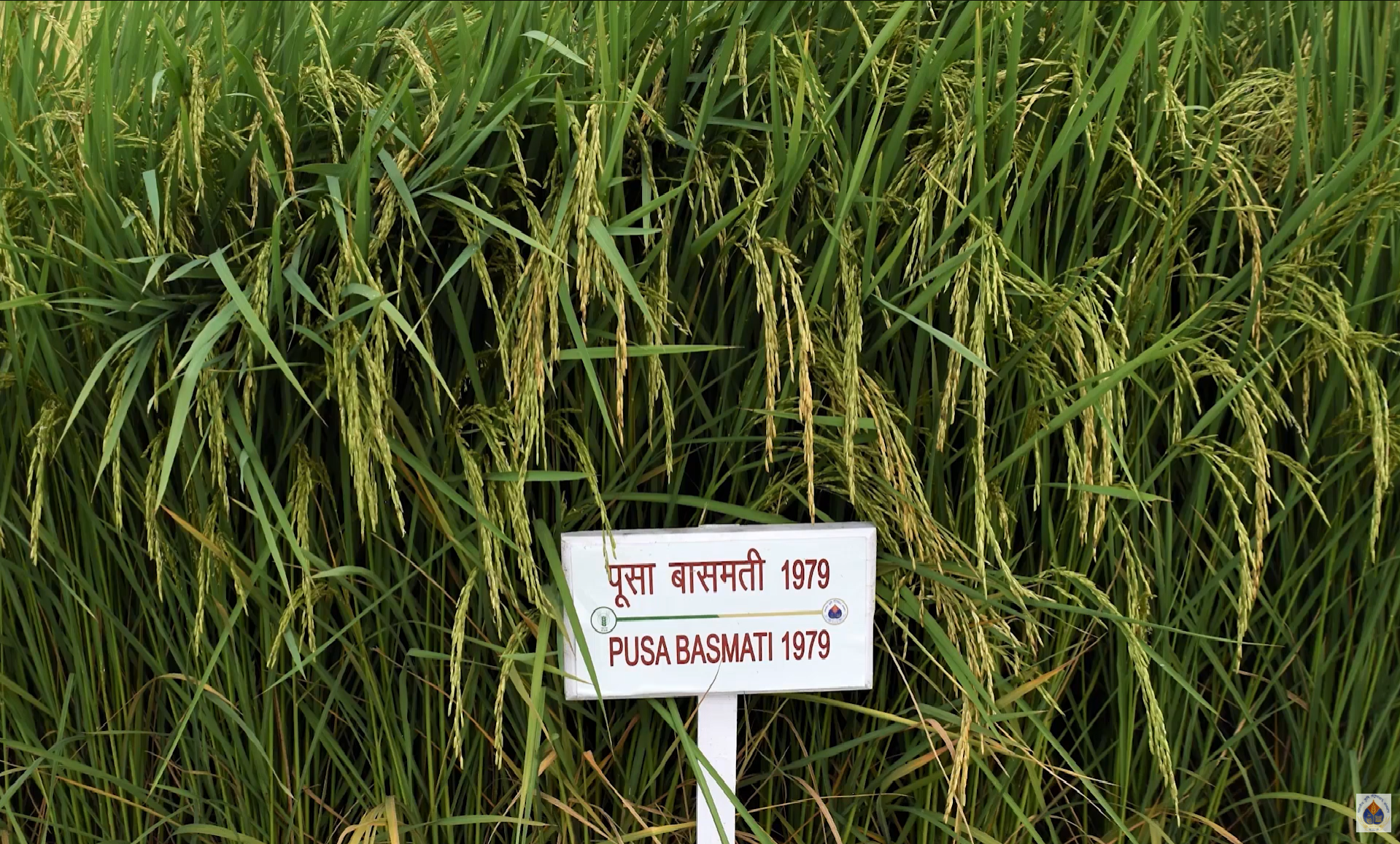
Pusa Basmati 1979 Rice Variety: Herbicide Tolerant Basmati for Direct Seeded Rice (DSR)
Pusa Basmati 1979 (IET 28812) is a herbicide tolerant basmati rice variety developed by ICAR–Indian Agricultural Research Institute (IARI), New Delhi. The variety is developed using Marker Assisted Selection (MAS) and is a near-isogenic line of Pusa Basmati 1121 with inbuilt tolerance to the herbicide Imazethapyr.
The variety has been designed especially for Direct Seeded Rice (DSR) cultivation where weed control is a major challenge. It provides excellent grain quality similar to Pusa Basmati 1121 while enabling efficient weed management through herbicide application. :contentReference[oaicite:0]{index=0}
Key Features of Pusa Basmati 1979
- Herbicide tolerant basmati rice variety
- Tolerant to Imazethapyr herbicide
- Suitable for Direct Seeded Rice cultivation
- Derived from Pusa Basmati 1121
- Excellent grain quality with strong aroma
- High yield potential around 4.6 t/ha
- Helps reduce weed management cost
- Suitable for basmati GI area of north-western India
Recommended Area
Pusa Basmati 1979 is recommended for cultivation in the Basmati GI region of India, particularly in the states of:
- Punjab
- Haryana
- Delhi
- Western Uttar Pradesh
These regions have suitable climatic conditions for high quality basmati rice production. :contentReference[oaicite:1]{index=1}
Land Preparation and Soil Requirements
- Suitable for irrigated lowland conditions
- Recommended soil pH range: 5 – 8
- Well prepared and leveled fields ensure uniform crop establishment
Sowing Time
- Direct Seeded Rice: 15 – 20 June
- Transplanting: Last week of June to first week of July
Timely sowing is important for achieving optimum yield and maintaining basmati grain quality. :contentReference[oaicite:2]{index=2}
Seed Rate and Spacing
- Transplanted crop: 5 kg seed per acre
- Direct Seeded Rice: 8 kg seed per acre
- Spacing: 20 cm × 20 cm
Fertilizer Management
- Nitrogen (N): 50 kg/acre
- Phosphorus (P₂O₅): 12 kg/acre
- Potassium (K₂O): 12 kg/acre
- Nitrogen should be applied in three split doses
- Green manuring with Dhaincha can reduce nitrogen requirement
Application of zinc sulphate is also recommended:
- Zinc Sulphate Heptahydrate: 10 kg/acre
- OR Zinc Sulphate Monohydrate: 6 kg/acre
Weed Management
Weed control is very important in Direct Seeded Rice cultivation. Pusa Basmati 1979 allows the use of Imazethapyr 10% SL herbicide.
- Application dose: 2.66 ml per litre of water
- Apply at 16–18 days after sowing
- Spray when weeds are at the two leaf stage
During herbicide spraying, the soil should have adequate moisture and drift of herbicide to nearby non-HT rice fields should be avoided. :contentReference[oaicite:3]{index=3}
Pest and Disease Management
Major Insect Pests
- Termite – Chlorpyriphos 20 EC @ 1.5 L/acre
- Stem borer – Cartap Hydrochloride 4G @ 4.5 kg/acre
- Leaf folder – Monocrotophos 36 EC @ 400 ml/acre
- Brown plant hopper – Imidacloprid 18.5 SL @ 40 ml/acre
Major Diseases
- Sheath blight – Hexaconazole 5 EC @ 300 ml/acre
- Blast – Tricyclazole @ 120 g/acre
Irrigation Management
The crop requires adequate irrigation throughout the growing period. Under Direct Seeded Rice conditions, the field should be maintained at field capacity.
Harvesting Time
- DSR conditions: 130 – 135 days after sowing
- Transplanted conditions: 140 – 145 days after sowing
Grain and Cooking Quality
- Grain length: 8.01 mm
- Kernel length after cooking: 17.29 mm
- Amylose content: 21.68%
- Strong basmati aroma
- Very occasional grain chalkiness
Expected Yield
Under recommended agronomic practices, the expected yield of Pusa Basmati 1979 is about:
- 18 – 24 quintals per acre
The variety performs well under both transplanted and Direct Seeded Rice conditions. :contentReference[oaicite:4]{index=4}
Conclusion
Pusa Basmati 1979 represents an important advancement in basmati rice cultivation by integrating herbicide tolerance with premium grain quality. The variety provides farmers with an effective solution for weed management in Direct Seeded Rice systems while maintaining the export quality standards of traditional basmati rice.