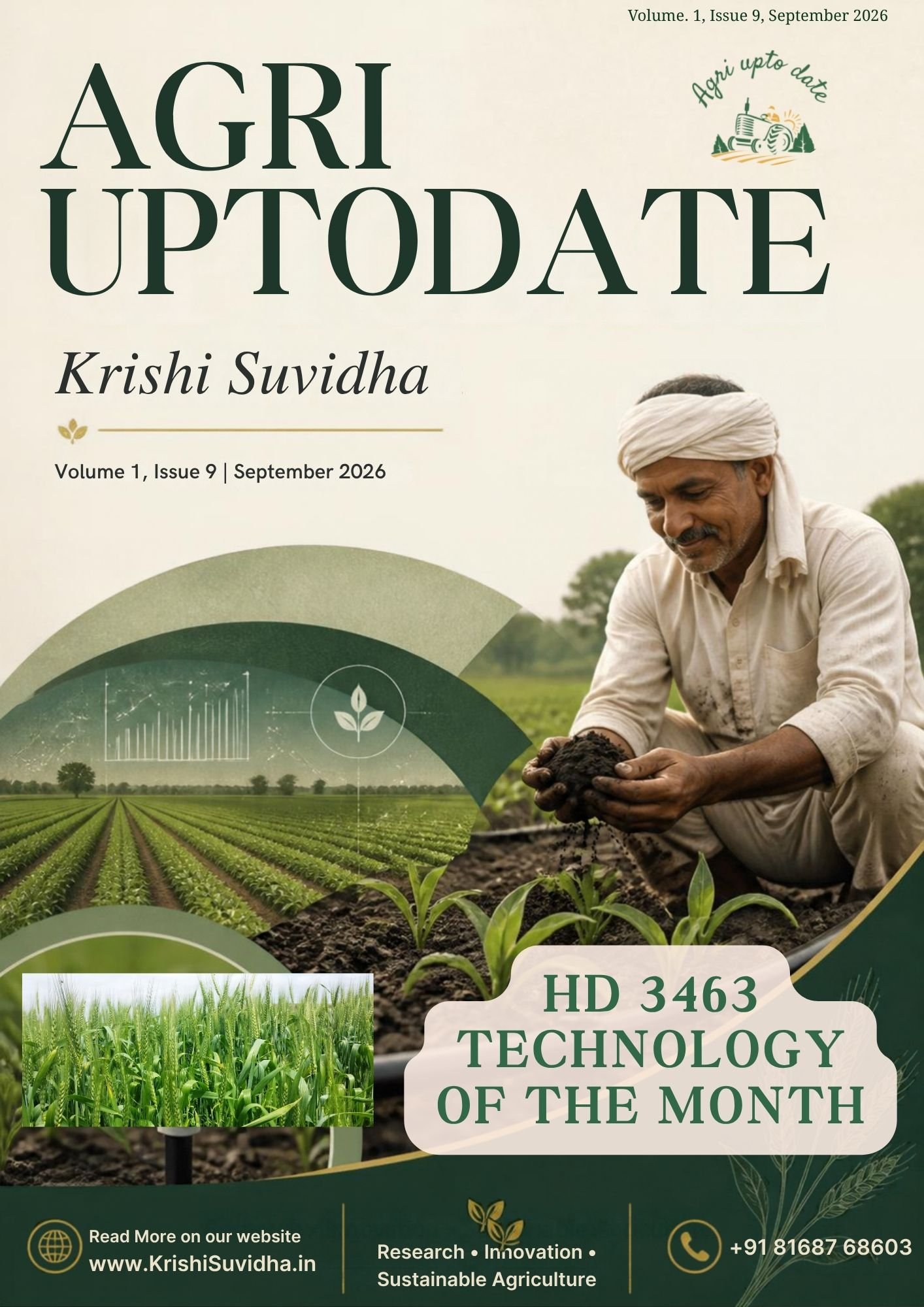
🌾 Bread Wheat Variety
HD 3463
Black rust-resistant, early-seeding bread wheat for Central Zone from ICAR-IARI, New Delhi
HD 3463 is a black rust-resistant bread wheat variety developed by ICAR-Indian Agricultural Research Institute (IARI), New Delhi. It is specifically designed for the Central Zone, where groundwater depletes toward the end of the cropping season (February onward), making early seeding essential for higher biomass and yield realization. HD 3463 addresses three major challenges: limited underground water, over-cultivation of Durum wheat leading to price crashes, and susceptibility of existing varieties to black rust.
📋 Variety Details
| Crop | Bread Wheat (Triticum aestivum) |
| Variety Name | HD 3463 |
| Developing Institute | ICAR-Indian Agricultural Research Institute, New Delhi |
| Target Ecology | Early seeding, heat tolerance |
| Target Zone | Central Zone (potential expansion to NWPZ) |
| Potential Area | ~10 million ha (expandable to 12 million ha) |
| Rust Resistance | Black rust (stem rust) & Yellow rust |
| Notification | Gazette No. S.O. 5500 (E) dated 8th Oct, 2026 |
| TRL Level | Released and notified |
| IP Status | PPVFR application likely to be filed within five days |
| Commercialization | Not done so far |
✨ Salient Features
- Black rust resistant — addresses the major issue of existing Central Zone varieties being susceptible to black rust, reducing crop losses and fungicide expenditure.
- Suitable for early seeding — designed for early sowing to use available water for higher biomass realization before groundwater depletes in February onward.
- Heat tolerance and adaptive mechanism for delayed heading — critical for early-seeded wheat in Central Zone conditions.
- High yield potential to compete with Durum wheat — provides a viable bread wheat alternative to combat the over-cultivation of Durum wheat and its associated price crashes.
- Also resistant to yellow rust — enabling potential expansion to the North-Western Plains Zone (NWPZ).
- Potential targeted area: ~10 million ha, with scope to expand to 12 million ha in NWPZ.
- Total targeted replacement: 1–4 million ha.
🔄 Targeted Replacement of Existing Varieties
| GW 322 | Complete replacement — ~200 q average of last five years |
| Pusa Tejas & Pusa Mangal (Durum wheat) | Partial replacement — ~700 q breeder seed average |
| GW 513 | ~400 q average of last two years |
| HI 1544 | ~100 q average |
| DBW 187 & DBW 327 | Less than 200,000 ha area |
🌱 Detailed Package of Practices (Wheat Cultivation for Central Zone)
Note: The TDF document for HD 3463 does not list variety-specific package of practices. The points below are standard wheat cultivation practices adapted for Central Zone conditions (early seeding, heat tolerance) compiled from ICAR-IIWBR / Vikaspedia for reference.
🌡️ Climate & Soil
Wheat is a cool-season crop; optimum temperature for germination is 20–25°C, for tillering 16–20°C, and for grain filling 20–25°C. For the Central Zone, early seeding (mid-October to early November) is recommended to escape terminal heat stress and utilize available soil moisture before groundwater depletion. HD 3463 shows heat tolerance and adaptive mechanism for delayed heading. It grows best in well-drained loam to clay loam soils with a pH range of 6.0–7.5.
🚜 Land Preparation
Prepare the field with 2–3 harrowings followed by planking to obtain a fine, clod-free seedbed. Retain adequate soil moisture at sowing. Incorporate 5–6 t/ha of well-decomposed FYM during the final ploughing.
🌾 Seed Rate & Seed Treatment
Seed rate: 100 kg/ha for timely-sown irrigated wheat (higher seed rate of 125 kg/ha for late sowing).
Seed treatment: Treat seed with Carboxin 37.5% + Thiram 37.5% @ 2 g/kg or Vitavax @ 2 g/kg to protect against loose smut and seed-borne diseases. For termite-prone areas, treat with Chlorpyriphos 20 EC @ 4 ml/kg seed.
Sowing: Sow in rows 20 cm apart at a depth of 5 cm using a seed drill or by the pora method.
🧪 Manures & Fertilizers
FYM: 5–6 t/ha incorporated during land preparation.
Recommended fertilizer dose: 150 kg N, 60 kg P₂O₅ and 40 kg K₂O per hectare for irrigated timely-sown wheat.
Application: Apply half of N and full P & K as basal at sowing. The remaining N is top-dressed in two equal splits — at first irrigation (CRI stage, 20–25 DAS) and at second irrigation (tillering stage, 40–45 DAS). Apply zinc sulphate @ 25 kg/ha if soil is deficient in zinc.
💧 Irrigation
Irrigated wheat requires 4–6 irrigations depending on soil type and rainfall. Critical stages for irrigation:
- CRI (Crown Root Initiation) stage — 20–25 DAS (most critical)
- Tillering stage — 40–45 DAS
- Late jointing/booting stage — 60–65 DAS
- Flowering stage — 80–85 DAS
- Milk stage — 100–105 DAS
- Dough stage — 115–120 DAS
In the Central Zone, ensure adequate irrigation before groundwater depletion in February onward. Irrigate lightly at each stage, ensuring no water stagnation.
🧑🌾 Intercultural Operations
Weed control: Apply pre-emergence herbicide Pendimethalin @ 1.0 kg a.i./ha within 2–3 days of sowing. For post-emergence control, spray Sulfosulfuron @ 25 g a.i./ha at 30–35 DAS. One hand weeding at 30–35 DAS may be needed.
Earthing up: Not commonly required for wheat, but light hoeing may help in heavy soils.
🛡️ Plant Protection
Major pests: Aphids, termites, and pink stem borer.
- Aphids: Spray Dimethoate 30 EC @ 1 ml/litre or Imidacloprid 17.8 SL @ 0.3 ml/litre
- Termites: Apply Chlorpyriphos 20 EC @ 4 ml/kg as seed treatment
- Pink stem borer: Apply Carbofuran 3G @ 25 kg/ha at the base of plants
Major diseases: Black rust (stem rust), yellow rust, brown/leaf rust, loose smut, and powdery mildew.
- Black rust: HD 3463 is resistant, addressing a major gap in Central Zone varieties. For susceptible checks, spray Propiconazole 25 EC @ 1 ml/litre at first appearance
- Loose smut: Carboxin seed treatment
- Powdery mildew: Spray Wettable Sulphur @ 2 g/litre
🧺 Harvesting
Wheat matures in about 140–150 days after sowing for timely-sown varieties. Harvest when the crop turns golden yellow, grains become hard, and moisture content drops to 14–16%. Combine harvesting or manual harvesting followed by threshing is practiced. Store grain at 10–12% moisture in clean, dry bins.
📦 Post-Harvest Management
Clean, dry and grade the grain before storage. Store in airtight containers or warehouses to prevent insect infestation. Use of neem leaves or fumigants may help in long-term storage.
📈 Market & Commercialization Potential
🎯 Target Geography
Central Zone is the primary target with approximately 10 million ha of wheat cultivation. The variety has potential to expand to 12 million ha in the North-Western Plains Zone (NWPZ) as it is also resistant to yellow rust.
🥇 Competitive Positioning
HD 3463 is positioned as a replacement for existing varieties such as GW 322, HI 1544, Pusa Tejas (HI 8759), HI 8850, HI 1650, GW 513, DBW 187 and DBW 327. Its high yield potential enables it to compete with Durum wheat, providing a market-stable bread wheat alternative for farmers.
💰 Farmer-Level Economic Benefits
HD 3463 offers a high yield potential that can compete with Durum wheat, helping farmers avoid the price crashes associated with over-cultivation of Durum. Additionally, resistance to black rust and yellow rust can reduce crop losses and fungicide expenditure, strengthening its value proposition.
📊 Potential Area Adoption & Replacement
| Potential targeted area (Central Zone) | ~10 million ha |
| Potential expansion (NWPZ) | Up to 12 million ha |
| Total targeted replacement | 1–4 million ha |
| Anticipated sale (first 3 years) | ~1 lakh tonnes |
🌱 Seed Production & Pricing
Developmental cost at lab scale: Rs 30–35 per kg
Expected selling price: Rs 37–60 per kg
Proposed ceiling on selling price: Not intended
🤝 Target Clients / Investors
Seed producers, Farmer Producer Organizations (FPOs), and medium to large seed companies.
⚠️ Limiting Factor
Highly competitive market.
🤝 Proposed Licensing Terms
| Nature of License | Exclusive / Non-exclusive |
| Duration of License | As per agreement |
| Licensee Fee | ₹50,000/- |
| Royalty | ₹20 per kg on breeder seed |
| Licensed Territory | India |
| Raw Material to be Transferred | 50–100 kg breeder seed per licensee |
| Cost of Raw Material | Breeder cost (₹85/-) + ₹20/- |
| Timeline for Transfer | Immediate |
| Handholding / Training | Not required |
🌍 Anticipated Social Impact
HD 3463 can provide buffering against uncertainty in crop production and contribute to better nutrition and social security. By offering a high-yielding, disease-resistant bread wheat alternative to Durum wheat, it helps stabilize farmer incomes, reduces dependence on a single market segment, and strengthens food security in the Central Zone. Wider adoption will diversify the varietal base, generate employment through seed production and distribution, and promote sustainable wheat production in water-scarce regions.
💰 Technology Developmental Cost
Total cost required to complete this innovation: ₹38,83,389/- (Rupees thirty-eight lakh eighty-three thousand three hundred and eighty-nine only), including manpower, equipment, raw material and all other resources. Scientific manpower cost is included.
❓ Frequently Asked Questions
What is HD 3463 wheat variety?
HD 3463 is a black rust-resistant bread wheat variety from ICAR-IARI, developed for the Central Zone with early seeding suitability, heat tolerance, and high yield potential to compete with Durum wheat.
Why was HD 3463 developed?
It addresses three major Central Zone issues: limited underground water requiring early seeding, over-cultivation of Durum wheat causing price crashes, and susceptibility of existing varieties to black rust.
Which areas is HD 3463 recommended for?
Central Zone (~10 million ha) with potential expansion to North-Western Plains Zone (up to 12 million ha) as it is also resistant to yellow rust.
What diseases is HD 3463 resistant to?
HD 3463 is resistant to black rust (stem rust) and yellow rust.
What is the selling price of HD 3463 seed?
The expected selling price is Rs 37–60 per kg. Breeder seed cost is Rs 85/- plus Rs 20/- royalty per kg.
What are the licensing terms for HD 3463?
Exclusive/non-exclusive license, ₹50,000 licensee fee, ₹20/kg royalty on breeder seed, India territory, 50–100 kg breeder seed transfer per licensee immediately after agreement.
Sources: AgIn Technology Disclosure Form (TDF) — Technology: HD 3463, ICAR-IARI, New Delhi. General wheat cultivation practices compiled from ICAR-IIWBR Karnal and Vikaspedia recommendations.