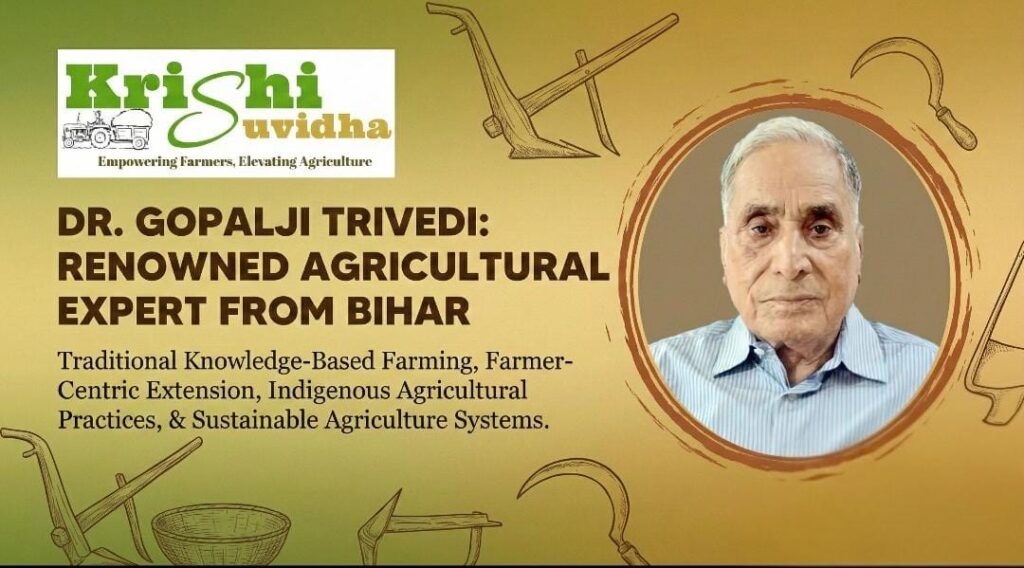
🌾 Dr. Gopalji Trivedi: Padma Shri Awardee and Champion of Traditional Knowledge–Based Agriculture in Bihar
🏆 Padma Shri Award: National Recognition for Grassroots Agricultural Excellence
Dr. Gopalji Trivedi was honored with the Padma Shri, one of India’s highest civilian awards, in recognition of his outstanding contribution to traditional knowledge–based agriculture, farmer-centric extension, and sustainable rural development in Bihar. He received this prestigious award for reviving indigenous agricultural practices, scientifically validating farmer wisdom, and empowering small and marginal farmers through participatory extension approaches. His work strengthened sustainable farming systems, preserved local agricultural heritage, and improved livelihoods in resource-poor rural communities.
📘 Introduction
Dr. Gopalji Trivedi is a well-known agricultural expert from Bihar, recognized for his lifelong contribution to traditional knowledge–based agriculture, farmer-centric extension, and sustainable farming systems. His work emphasizes the revival, scientific validation, and field-level application of indigenous agricultural practices, particularly suited to small and marginal farmers of eastern India.
🎓 Background and Education
Dr. Gopalji Trivedi pursued formal education in agriculture and rural development, with a strong inclination toward extension education and indigenous farming systems. Growing up and working closely with farming communities in Bihar deeply influenced his understanding of local agro-ecological conditions, farmer wisdom, and region-specific constraints.
His academic background enabled him to bridge the gap between:
- Traditional farmer knowledge
- Scientific agricultural principles
- Practical field-level extension
🧭 Field of Specialization
- Traditional and Indigenous Agricultural Knowledge Systems
- Agricultural Extension Education
- Low-input and sustainable farming
- Farmer-led innovation and participatory learning
- Rainfed and resource-poor farming systems of Bihar
His work strongly advocates that traditional knowledge, when refined scientifically, can offer resilient solutions to modern agricultural challenges.
🌱 Contribution to Traditional Knowledge–Based Agriculture
🔄 Revival of Indigenous Farming Practices
Dr. Gopalji Trivedi has extensively worked on identifying, documenting, and promoting traditional agricultural practices such as:
- Indigenous seed selection and conservation
- Traditional soil fertility management
- Natural pest and disease control methods
- Mixed cropping and crop diversity systems
These practices are particularly relevant for regions like Bihar, where small holdings and limited resources dominate.
🧪 Integration of Traditional Knowledge with Modern Science
Rather than opposing modern agriculture, Dr. Trivedi emphasized integration. His approach focused on:
- Validating traditional practices through scientific reasoning
- Improving their efficiency without increasing cost
- Making agriculture more locally adaptive and sustainable
This balanced approach increased farmer acceptance and long-term adoption.
👨🌾 Role in Agricultural Extension
🤝 Farmer-Centric Extension Model
- Two-way learning between scientists and farmers
- Participatory demonstrations and field schools
- Community-based knowledge sharing
This approach empowered farmers and improved trust in extension systems.
📚 Training and Capacity Building
- Farmer training programs
- Awareness campaigns on sustainable agriculture
- Capacity building of extension workers
- Promotion of low-cost technologies
His programs were designed especially for small and marginal farmers, women farmers, and rural youth.
📖 Research and Documentation Work
- Documentation of indigenous agricultural practices of Bihar
- Case studies on farmer innovations
- Research on sustainability and resilience of traditional systems
His research helped preserve valuable traditional knowledge that might otherwise have been lost due to rapid modernization.
🌍 Contribution to Sustainable and Natural Farming
- Reduced chemical dependency
- Soil health restoration through organic inputs
- Ecological balance in farming systems
His ideas align closely with present-day concepts of natural farming, organic agriculture, and climate-resilient farming.
🏘️ Impact on Farmers and Rural Communities
- Reducing cost of cultivation
- Improving self-reliance among farmers
- Preserving local crop diversity
- Strengthening community-based farming systems
His extension efforts helped farmers regain confidence in their own knowledge and skills.
🎓 Academic and Social Contribution
- Writing articles and resource materials on traditional agriculture
- Participating in seminars, workshops, and farmer meetings
- Advising institutions and development programs on extension strategies
His work reflects a rare blend of academic insight and grassroots engagement.
🌾 Significance in the Context of Bihar Agriculture
- Small landholdings
- High dependence on natural resources
- Vulnerability to floods and climate stress
Dr. Trivedi’s emphasis on traditional knowledge-based agriculture offers region-specific, low-risk solutions that are socially acceptable and environmentally sound.
🕊️ Legacy and Relevance Today
- Climate change challenges
- Rising input costs
- Need for sustainable agriculture
- Revival of indigenous knowledge systems
His work continues to inspire extension professionals, researchers, and farmers to view traditional knowledge not as outdated, but as a foundation for future agriculture.