
General Information
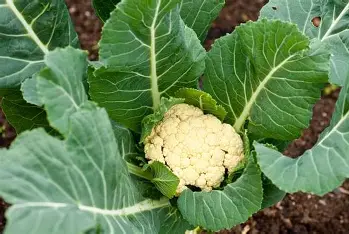
Cauliflower is cultivated for its shortened flower parts or mass composed of close aggregation of abortive flowers developed on thick bunch of inflorescence which are used as vegetables, soup, curries and pickling. Consumption of cauliflower provide vitamin B, vitamin E, and also a fair amount of protein. It is also an excellent source of folic acid and dietary fibre which have anti-cancer properties. UP rank ninth in cauliflower production.
CLIMATE
| Temperature | Rainfall | Sowing Temperature | Harvesting Temperature |
| 15 °C – 25 °C | 200- 500 mm | 10 °C – 20 °C | 17°C- 20 °C |
Cauliflower grows best in a cool and moist climate, with an optimum temperature range of 15–25 °C and annual rainfall of about 200–500 mm. The ideal sowing temperature is 10–20 °C, while for proper curd development and harvesting, a cooler range of 17–20 °C is most suitable.
SOIL
Cauliflower can be grown on any good soil (sandy loam, silt loams and clay loams.) but fairly deep loamy soils are preferable for growing cauliflower. For early crops, the light soils are preferred, while, loamy and clay loam soils are more suitable for mid season and late maturing types. Cauliflower is sensitive to high acidity. It requires an average pH of 6 to 6.5. The soil should be properly drained and rich in organic matter.
VARIETES
Early varieties
DC 31
Suitable for July transplanting and reaches marketable maturity during October. Curds compact with retentive white colour. C weight 500-600g with yield potential of 160-180q/ha.
Early Kunwari
It is one of the earliest maturing cauliflower varieties, well-suited for regions with relatively mild and short winters. It produces compact, medium-sized curds with good white colour. The plants are hardy, capable of tolerating early-season climatic variations, and yield around 120–150 quintals per hectare.
Sabour Agrim
It is an early maturing cauliflower variety. It produces compact, medium to large curds that are creamy-white in colour and well covered by leaves, protecting them from sun-scorching. The maturity period is about 90–100days, making it suitable for early market supply. The average yield ranges between 160–180 quintals per hectare, and because of its early harvesting, it ensures better prices in the market.
Pusa Early Synthetic
Its is a popular early-season cauliflower variety developed for northern India. It matures quickly within 90–100 days after sowing, producing snow-white, medium-sized curds. The curds are firm, with good market appeal, and the variety performs well under higher temperatures compared to late types. Its average production ranges from 150–170 quintals per hectare.
Pant Gobhi 3
It is another early cauliflower variety, developed by Pantnagar University. It forms compact, well-covered curds with a white to creamy-white appearance. The plants show good adaptability to variable climatic conditions and produce around 160–180 quintals per hectare. The variety is favored in North Indian plains for early planting due to its better heat tolerance and quality curd formation.
Pusa Deepali
It is an early-season variety suitable for planting in areas where winters are not very severe. It produces medium-large, white, and compact curds with a smooth surface. The maturity period is about 95–100 days, and the yield potential is around 140–160 quintals per hectare. It is preferred by farmers for its early harvesting and good shelf-life of the curds.
Pant Gobhi 2
It is an early-maturing cauliflower variety with attractive white curds of medium size. It has a maturity duration of around 90–95 days and adapts well to subtropical climates. This variety provides an average yield of 150–170 quintals per hectare and is appreciated for its uniform curd development and better tolerance to pests under early conditions.
KTH-301
It is a hybrid variety which is suitable for cultivation in the mid-season with the harvesting curd in the month of November-December; Yield: 390 q/ha.
Improved Japanese
It is a mid-early cauliflower variety widely grown in India. It produces large, compact, and creamy-white curds with smooth surfaces. The plants are vigorous, producing a good leaf cover that protects the curd from discoloration. The crop matures in about 110–120 days, with a production potential of 180–200 quintals per hectare.
Pusa Hybrid-2
It is a mid-early hybrid variety known for its high yield and quality curds. It matures within 115–120 days and produces large, snow-white, compact curds with excellent market value. It has good tolerance to temperature fluctuations and gives an average yield of 220–250 quintals per hectare. Farmers prefer this variety due to its uniform curds and higher returns from hybrid vigour.
Pusa Sharad
It is a mid-early variety. It produces well-developed, compact, snow-white curds that are smooth and highly attractive. The crop matures in 110–115 days and yields about 180–200 quintals per hectare. It performs well in the plains during the main season and has better adaptability compared to other mid-early types.
Pant Gobhi 4
It is a mid-early cauliflower variety suitable for cultivation in North Indian states. It forms medium to large compact curds that are creamy-white with good firmness. It matures in 110–120 days and yields around 170–190 quintals per hectare. Farmers appreciate this variety for its good curd quality and adaptability under mid-season climatic conditions.
Late varieties
Pusa Synthetic
It is a mid-late maturing cauliflower variety that produces large, compact, and snow-white curds. Maturity occurs around 125–130 days after sowing. Its average yield potential is 200–220 quintals per hectare. It is well-suited for main-season and slightly late sowing, making it a reliable choice for farmers.
Pant Shubhra
It is a mid-late variety of cauliflower developed for Northern plains. It produces medium-large, snow-white, compact curds with smooth surfaces. The maturity period is around 120–130 days, and the variety yields about 190–210 quintals per hectare. It is known for its adaptability, better shelf life, and disease tolerance, which makes it profitable for commercial cultivation.
Pusa Shubhra
It is a mid-late cauliflower variety with high-quality, snow-white curds. It takes about 125–135 days to mature and produces medium-large curds with firm texture. Its yield potential is 200–220 quintals per hectare under proper management. Farmers value this variety for its uniform curds, excellent cooking quality, and better market acceptance during the late season.
Pusa Himjyoti
Itis a mid-late variety recommended for cooler regions and foothills. It produces medium to large compact curds with a snow-white appearance. The crop matures within 120–130 days and yields around 190–210 quintals per hectare. It performs well in areas with relatively lower temperatures, ensuring better curd development and market preference.
Punjab Giant 35
It is a mid-late variety of cauliflower developed by Punjab Agricultural University. It produces large, dome-shaped, compact, and white curds with excellent firmness. The plants are vigorous and cover the curd well, protecting it from sun-scorching. It matures within 125–135 days and yields about 200–220 quintals per hectare. It is highly popular in Punjab and adjoining states.
Pusa Snowball-1
It is a late-maturing cauliflower variety, ideal for cold regions and late-season planting. It produces pure white, large, compact curds with smooth texture and excellent firmness. The crop matures in about 140–150 days and yields 200–220 quintals per hectare. It is well-suited for winter harvesting when temperatures are low, and it commands high market demand due to quality curds.
Pusa Snowball K-1
It is another late cauliflower variety that produces excellent quality, snow-white compact curds. It matures in 140–150 days and gives a yield of about 210–230 quintals per hectare. The variety is especially suitable for late sowing in North India and hilly regions. Farmers choose this variety for its high market preference and strong tolerance to cold conditions.
Ooty-1
It is a late-maturing cauliflower variety specifically recommended for cultivation in the Nilgiri hills and other cooler hill stations. It produces large, firm, and snow-white curds of excellent quality. The maturity period ranges from 150–160 days, with a yield potential of 200–220 quintals per hectare. It thrives best in cool climates and is highly popular among farmers in southern hill regions for its superior curd quality and prolonged market availability.
Other varieties
Kashi Gobhi-25, Pusa Shukti, Pusa Paushja, Pusa Katki, Pusa Himani, Pusa Snowball-16, Sabour Shresth, Sabour Agrim-2, Kalyanpur Early, Arka Kanchan, and Arka Sharad, Patna Main, Aghani, Poosi, Pusa Meghna.
Field Preparation
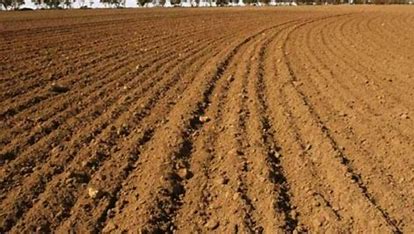
The soil should come to fine tilth for which 5-6 ploughing followed by planking after each ploughing. The soil should be free from the weeds and debris.
Nursery raising
Cauliflower seedlings are raised in well-prepared, weed- and disease-free nursery beds of 8.0 × 1.0 m size and 15–20 cm height, with about 15 such beds required for one hectare of land. Each bed should be enriched with 2–3 kg/m² of well-decomposed farmyard manure or compost. For early crops, 500–600 g seed per hectare is required, while for late crops 350–400 g seed is sufficient. Seeds are sown 1–2 cm deep at 4–5 cm spacing in rows 10 cm apart and covered with a fine mixture of soil and manure. A regular supply of moisture is essential for germination, and to prevent diseases the seedbeds should be drenched with Captan solution (2 g/L of water).
Transplanting
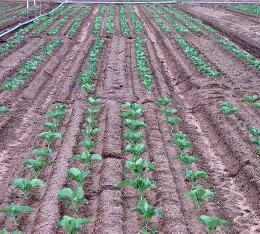
Seedlings aged 5–6 weeks are ideal for transplanting. Hardening is achieved by withholding irrigation for 4–5 days before uprooting, while beds are irrigated thoroughly a day before transplanting to ease lifting. Afternoon transplanting is preferred for better survival. The field should be prepared by ploughing and harrowing to a fine tilth, and planting may be done on flat land or by the ridge and furrow method, the latter being especially suitable in rain regions.
Sowing
Time of sowing
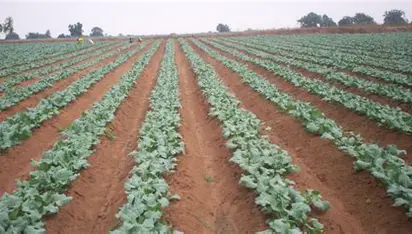
Cauliflower is are sown at multiple time which are Early Varieties which are sowing in the nursery is done from mid-May to July. The seedlings are transplanted in July–August while the Late varieties nursery sowing at September – October. Transplanting is done in November.
Spacing
Spacing depends on the crop season: 45 × 45 cm for early crops and 50–60 × 60 cm or 60 x 45 cm for mid- and late-season crops.
Methods of sowing
Transplanting nursery-raised seedlings
Healthy seedlings of about 4–6 weeks are carefully uprooted, roots dipped in fungicide solution (like Carbendazim 0.1%), and transplanted into the well-prepared main field.
Direct sowing
Farmers practice direct sowing of cauliflower seeds in the main field. Seeds are dibbled at proper spacing and later thinned to maintain plant population.
Seed
Seed rate
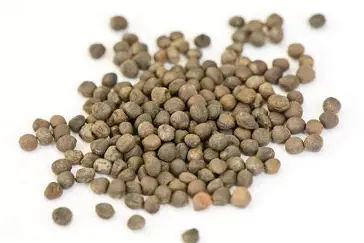
For cauliflower cultivation, the seed rate varies with the season / maturity of variety. Early varieties require around 500- 600 g. For Late varieties, the seed rate is 400 g- 300 g per hectare. Using the right seed rate ensures optimum plant population and better yield.

Seed treatment
Seeds are treated with fungicides as Carbendazim or Thiram at the rate of 2–3 g per kg of seed. For better disease prevention, a mixture of Thiram (2 g) + Carbendazim (1 g) per kgof seed is highly effective. For areas prone to bacterial diseases, treating seeds with a solution of Streptocycline (0.01%) for 30 minutes is recommended.
Seed Inoculation
For boosting germination and seedling vigour, seeds can be treated with Trichoderma viride bio-agent at 4 g per kg seed.
Manure
Farm Yard Manure (FYM)
It enhances organic matter content and naturally adds nitrogen to the soil, benefiting the succeeding the crop growth. About 20–25 tonnes of well-decomposed farmyard manure (FYM) per hectare should be applied during land preparation to improve soil fertility, structure, and moisture retention. Along with FYM, incorporation of vermicompost (2–3 tonnes/ha) is added which help in improves soil fertility, enhances aeration and moisture retention, and promotes healthy growth in cauliflower and other crops.

Fertilizer
Nutrient Requirement (kg per hectare)
| NITROGEN | PHOSPHORUS | POTASH |
| 150 kg | 60 – 80 kg | 80 kg |
Fertilizer Requirement (kg per hectare)
| UREA | SSP | MOP |
| 326 kg | 466 kg | 133 kg |
Note:
During field preparation, apply half of the nitrogen dose along with the full amounts of phosphorus and potassium. The remaining nitrogen should be top-dressed about four weeks after transplanting.
It is also recommended to apply borax at 15 kg/ha for boron and ammonium molybdate at 15 kg/ha for molybdenum to ensure proper crop growth and curd development.
Weed control
Hoeing and weeding are done around 30 and 45 days after planting. Weed control can be effectively managed using pre-plant incorporation of herbicides such as Fluchloralin (0.75–1.5 kg/ha) or Pendimethalin (1.0 kg/ha), or through post-transplant application of Alachlor (1–2 kg/ha).
Intercultural Operation
Blanching
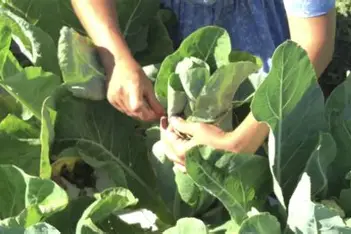
Blanching is the practice of protecting cauliflower curds from direct sunlight to maintain their whiteness, tenderness, and flavour. This is done by lifting the outer leaves over the curds and tying them with twine or a rubber band. The blanching period lasts for 3–5 days in hot weather and 8–10 days in cool weather. Prolonged blanching may cause curd rotting and discoloration. Late-season varieties and self-blanching types usually do not require this practice.
Nutrient Deficiency
Boron (B) Deficiency
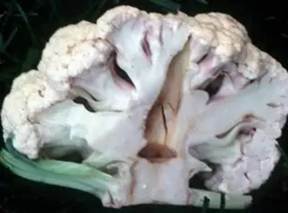
It causes brown patches on curds (brown rot), development of hollow stems, and cracked midribs in leaves.
Corrective Measure:
To manage boron deficiency, it is recommended to apply Borax at 10–15 kg per hectare to the soil.
Molybdenum (Mo) Deficiency
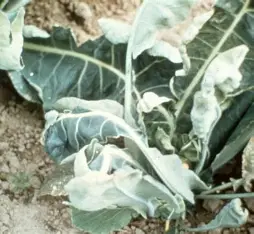
The most characteristic symptom is whiptail disorder, where leaf blades fail to expand properly, leaving narrow, strap-like leaves, which leads to poor plant vigour and reduced curd formation.
Corrective Measure:
This deficiency can be corrected by applying Ammonium molybdate at 1–1.5 kg per hectare.
Irrigation
Irrigation should be provided immediately after transplanting. For the early crop, watering is required every 5–7 days, whereas mid- and late-season crops need irrigation at intervals of 8–12 days. Adequate soil moisture during the curd formation stage is particularly important for ensuring good quality produce.
Plant protection
Insect Pests and Their Control
| Pest/Insect | Symptoms | Peak Stage of Infestation | Treatment |
| Diamondback Moth | Small holes on leaves, skeletonization, curd contamination by larvae | Vegetative to curd formation stage, especially in dry warm weather | Spray Bt formulations, neem (Azadirachtin 0.03% @ 2 ml/L); in severe cases use Emamectin benzoate 5 SG @ 0.4 g/L |
| Cabbage Aphid | Clusters of aphids suck sap, leaves curl & yellow, honeydew → sooty mold | Cool season (Dec–Jan) | Spray Imidacloprid 17.8 SL @ 0.3 ml/L or Thiamethoxam 25 WG @ 0.25 g/L; neem oil (2%) for eco-friendly control |
| Tobacco Caterpillar | Leaves with irregular holes, skeletonization; may destroy seedlings | Nursery & early vegetative stage, hot humid weather | Handpick egg masses; spray Spinosad 45 SC @ 0.3 ml/L or Chlorantraniliprole 18.5 SC @ 0.4 ml/L; neem cake use |
| Painted Bug | Sap sucking from shoots & leaves → yellowing, wilting, stunted seedlings | Early growth stage (nursery to transplanting), dry weather | Spray Malathion 50 EC @ 1 ml/L or Dimethoate 30 EC @ 1 ml/L; neem cake protection effective |
| Cabbage Caterpillar | Large irregular holes on leaves/curds; reduced photosynthesis; curd contamination | Vegetative to harvest stage, peak in cooler months | Spray Bt formulations or Chlorpyriphos 20 EC @ 2 ml/L; monitor regularly |
Diamondback Moth
Symptoms:
The Diamondback Moth larvae feed on the undersides of cauliflower leaves, creating small holes and skeletonizing the foliage. Severe infestations reduce photosynthesis, stunt plant growth, and contaminate curds with caterpillars and frass, making them unmarketable.

Management
Spray Bacillus thuringiensis (Bt) formulations or neem-based insecticides (Azadirachtin 0.03% EC @ 2 ml/L). In severe cases, use Emamectin benzoate 5 SG @ 0.4 g/L.
Cabbage Aphid
Symptoms:
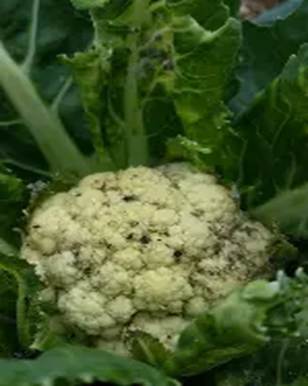
Clusters of small, soft-bodied insects suck sap from tender leaves, inflorescence, and curds; leaves curl, turn yellow, and growth is stunted. Honeydew secretion leads to sooty mold on curd of the cauliflower .
Management
Spray imidacloprid 17.8 SL@ 0.3 ml/L or Thiomethoxam 25 WG @ 0.25 g/L. Neem oil (2%) can be used for eco-friendly management.
Tobacco Caterpillar
Symptoms:
It damages cauliflower by feeding aggressively on the leaves, creating irregular holes and skeletonized lamina. In severe cases, the pest can completely destroy seedlings and young plants, leading to significant crop loss.

Management
Handpick and destroy egg masses. Use Spinosad 45 SC @ 0.3 ml/L or chlorantraniliprole 18.5 SC @ 0.4 ml/L. Neem cake application also reduces larval population.
Painted Bug
Symptoms:
Sucks sap from tender shoots and leaves, causing yellowing, wilting, and stunted growth. Seedlings are most vulnerable and may die.

Management:
Spray malathion 50 EC @ 1 ml/L or Dimethoate 30 EC @ 1 ml/L. Seedling protection with neem cake is also effective.
Cabbage Caterpillar
Symptoms:
Attacks cauliflower by green larvae feeding on leaves and curds, causing large irregular holes. Under heavy infestation, it reduces photosynthesis, weakens plant growth, and contaminates the curds, lowering their market value.

Management:
Spray Bt formulations or chlorpyriphos 20 EC @ 2 ml/L. Regular monitoring is essential during curd formation stage.
Diseases and their management
| Disease | Symptoms | Peak Stage of Infestation | Treatment |
| Damping-off | Seedlings rot at collar region, wilt and collapse; poor germination in nursery. | Nursery stage (young seedlings before transplanting). | Raise seedlings in sterilized, well-drained beds; treat seeds with Captan/Thiram @ 2–3 g/kg; drench soil with Captan (2 g/L). |
| Black Rot | V-shaped yellow lesions from leaf margins; blackened veins; discolored curds. | From early growth to curd formation stage. | Use disease-free seeds and resistant varieties; hot water seed treatment (50 °C for 30 min); crop rotation; spray copper oxychloride or Streptocycline. |
| Downy Mildew | Pale yellow patches on upper leaves; white downy growth on underside; stunted curds. | Cool and humid weather during vegetative to curd stage. | Ensure good drainage and aeration; spray Mancozeb or Metalaxyl @ 0.2%. |
| Alternaria Leaf Spot | Circular dark lesions with concentric rings; premature drying of leaves. | More severe at pre-curd and curd development stages. | Destroy infected residues; spray Mancozeb or Chlorothalonil @ 0.2% at intervals. |
| Club Root | Roots swollen and club-shaped; plants stunted, show wilting in hot weather. | Peak during active vegetative growth (warm & moist soil). | Practice long crop rotation; apply lime (5–10 q/ha) to raise soil pH > 7.2; use healthy seedlings. |
Damping-off
Symptoms:
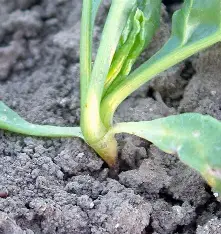
Causes rotting at the collar region of seedlings, leading to wilting, collapse, and patchy nursery growth. It is most severe under high moisture and poor drainage, resulting in poor crop stand.
Management
Raise seedlings in well-drained, sterilized nursery beds. Treat seeds with Captan or Thiram @ 2–3 g/kg, and drench the nursery soil with Captan solution (2 g/L water).
Black Rot
Symptoms
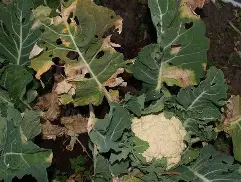
Appears as V-shaped yellow lesions from the leaf margins, with veins turning black due to bacterial infection. As it spreads, curds become discoloured and unmarketable. Warm, humid conditions favour its outbreak, and it often spreads through infected seeds or residues.
Management
Use disease-free seeds, resistant varieties, and treat seeds with hot water at 50 °C for 30 minutes. Adopt crop rotation with non-crucifers and spray with copper oxychloride or Streptocycline.
Downy Mildew
Symptoms
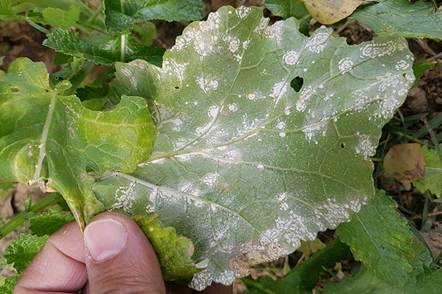
Pale yellow patches appear on upper leaf surfaces, with white downy fungal growth on the underside. Curds become stunted and plants appear weak.
Management
Maintain good field drainage and aeration. Spray Mancozeb or Metalaxyl @ 0.2% to check disease spread.
Alternaria Leaf Spot
Symptoms
It is characterized by circular dark brown to black lesions with distinct concentric rings on the leaves. These spots gradually enlarge, causing leaves to dry, wither, and fall prematurely. Severe infection weakens the plant, reduces photosynthesis, and leads to poor curd development.
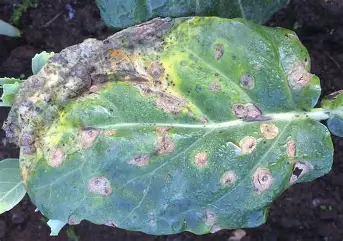
Management
Remove and destroy infected residues. Spray Mancozeb or Chlorothalonil @ 0.2% at intervals to control the disease.
Club Root
Symptoms
It is caused by abnormal swelling of roots, which become club-shaped and deformed. Affected plants show poor growth, yellowing, and wilting, especially during hot weather. Due to restricted root function, nutrient and water uptake is reduced, leading to stunted growth and low curd quality.
.

Management
Follow long crop rotation and apply lime (5–10 q/ha) to increase soil pH above 7.2. Use only healthy seedlings for transplanting.
Physiological Disorders of Cauliflower
Cauliflower suffers from several physiological disorders that reduce curd quality and market value. The major disorders and their management are as follows:
Fuzziness
It occurs when the flower pedicels elongate, giving curds a loose, velvety appearance and reducing market quality. It is commonly induced by growing the crop outside its ideal season or under unsuitable climatic conditions. Use of good-quality seeds and timely sowing with proper cultural practices helps in minimizing this disorder.
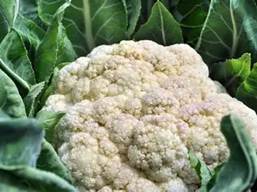
Management:
Managed by sowing good-quality, pure seeds in the recommended season and avoiding off-season planting. Proper cultural practices like balanced nutrition, timely irrigation, and maintaining suitable plant spacing help reduce the disorder and ensure better-quality curds.
Leafiness
It is characterized by the emergence of small, thin green leaves within the curd, which spoils its compact structure and market value. This disorder is often aggravated by high temperatures during the curding stage. Some varieties are more prone to leafiness, making variety selection and proper season-specific sowing crucial to minimize its incidence.

Management:
Managed by selecting varieties that are well-suited to local climatic conditions and less sensitive to the disorder. Timely sowing, according to the recommended season, helps avoid exposure to high temperatures during curd formation. Adopting proper cultural practices further ensures compact and good-quality curds.
Browning (Brown Rot/Red Rot)
This disorder in cauliflower occurs due to boron deficiency, often influenced by soil pH. Affected plants develop dark green, brittle young leaves that later show puckering and distortion, while older leaves become chlorotic and may drop prematurely. In severe cases, curd quality is also reduced, making it unfit for market.
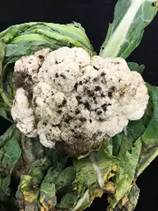
Management:
Apply Borax @ 20 kg/ha to soil, or spray 0.25–0.5% Borax solution in acute deficiency.
Whiptail
Whiptail disorder in cauliflower is mainly caused by molybdenum deficiency, which is common in acidic soils. Young leaves turn pale, chlorotic, and often become cupped or deformed, with the lamina reduced to narrow strips or just midribs. This results in poor plant growth and severely affects curd development.

Management:
Apply Lime/Dolomite to raise soil pH above 6.5 and use Sodium/Ammonium molybdate @ 1–2 kg/ha.
Buttoning
Buttoning in cauliflower occurs when plants develop very small curds resembling buttons due to poor vegetative growth. It is often caused by transplanting over-aged seedlings, poor nursery management, nutrient or moisture stress, and unfavorable weather such as hot, dry conditions. This leads to reduced yield and curds unsuitable for marketing.

Management:
Use healthy young seedlings, maintain proper nursery practices, ensure adequate moisture, and follow suitable variety-season combinations.
Harvesting
The harvesting is done as soon as the curd attains right maturity and they are compact, with white colour of the curds is maintained, If the harvesting is delayed, the curds become over mature, whose quality is deteriorated. Such curds may turn loose, leafy, ricey or fuzzy.
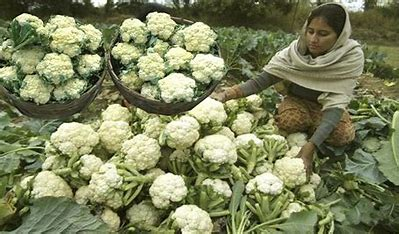
Post Harvest
The over mature curds should be sorted out while sending the produce to market. For harvesting, the curds are cut off stalk well below the curd with a sharp cutting knife or sickle Yield of the cauliflower varies greatly depending upon variety, maturity group and season. Cauliflower can be stored successfully at 0oC and 90-95 percent RH for 2-4 weeks.
Sources
ICAR e-lecture content on Cauliflower
Cauliflower production practices – National Horticulture Board