General Information
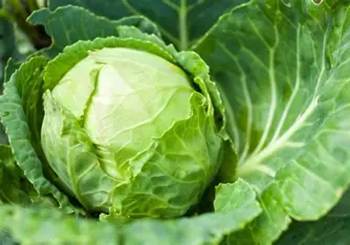
Cabbage is highly nutritious and is a rich source of Vitamin C and Vitamin K. It also contains good amounts of Vitamin B6 and folate. Among minerals, cabbage provides calcium, potassium, magnesium, manganese, and iron, which support strong bones, healthy heart, and overall body functions. It is used for curries, pickling etc. Cabbage pickle is called as Sauerkrat. Cabbage soup is good and nourishing. Cabbage has anticancer property. Cabbage is widely grown across India besides Uttar Pradesh. Major cabbage-producing states include Bihar, Orissa, West Bengal, Assam, Maharashtra, Karnataka, Madhya Pradesh, Gujarat, and Haryana. UP rank on eighth position in production of cabbage.
Climate
| Temperature | Rainfall | Sowing Temperature | Harvesting Temperature |
| 10 – 21ºC | 400- 500 mm | 12 – 16 ºC | 20 – 25 ºC |
Cabbage can be grown under a wide range of climate but cool moist climate is most suitable. It loses its flavour in dry warm weather. The optimum soil temperature for seed germination is 12 to 160 0C.
Soil
It can be grown in a wide range of sandy to well drained heavy soils but it prefers sandy loam soils. Early cultivars grow well in light soils while late maturing ones perform better on heavy well drained soils. The optimum soil pH for cabbage is between 6-6.5. Most cabbage cultivars are moderately tolerant to salt.
Varieties
Early Varieties
Golden Acre
Golden Acre is an early variety of cabbage that matures quickly and forms compact, round heads. The outer leaves are light green, while the inner leaves are dark green. Each head generally weighs between 1–1.5 kg and can be harvested about 60–65 days after transplanting. Delay in harvesting causes head cracking. The average yield is about 20–24 t/ha.
Early Drum Head
It is an early maturing variety which have flat, medium or large heads weighing 2–3 kg. It produces an average yield of 20–30 t/ha.
Pride of India
This is another early maturing variety, producing medium to large heads weighing 1–1.5 kg. The crop can be harvested 70–80 days after transplanting, with an average yield of 20–28 t/ha.
Copenhagen Market
A late maturing variety that is very popular, which produces large-sized heads weighing 2.5–3 kg each. The crop matures in about 75–80 days after transplanting.
Pusa Synthetic
Pusa Synthetic produces medium-sized heads and is known for its high yield potential. The average yield ranges between 35–46 t/ha.
Mid varieties
Pusa Mukta
This variety has medium-sized, flattish-round heads with light green outer leaves. Each head weighs 1.5–2 kg. It is tolerant to black rot disease and gives an average yield of 25–30 t/ha.
Midseason Market
This midseason variety forms round heads weighing 2–4 kg. The crop is ready for harvest within 80–90 days after transplanting.
September Early
A midseason variety popular in the Nilgiris, September Early produces compact, flat-oblong heads with bluish-green foliage. Each head weighs 4–6 kg and matures within 105–110 days after transplanting. Although susceptible to black rot, the heads do not crack easily and can remain in the field after maturity. Average yield is 40–50 t/ha.
Late varieties
Pusa Drumhead
This late season variety produces large, flat, somewhat loose, drum-shaped heads weighing 3–5 kg. Outer leaves are lighter in colour with a prominent midrib. It requires a long winter season for proper development and is tolerant to black leg disease. The average yield is 50–54 t/ha.
Late Large Drum Head
A late maturing variety with the compact, flat, uniform heads. It matures around 100–105 days after transplanting and yields about 20–30 t/ha.
K-1
K-1 variety produces large heads with inner leaves that are white in colour. It is tolerant to black rot disease and yields around 20–30 t/ha.
Jersey Wakefield
It is an early maturing cabbage variety with small to medium, conical heads weighing about 1–1.5 kg. It matures in 60–70 days, has tender green leaves, good taste, and is tolerant to splitting, making it suitable for early market supply.
Pusa Ageti
It is an early variety developed in India. It forms round, compact heads weighing about 1–2 kg and matures in 60–65 days. The leaves are light green, tender, and good in taste, making it suitable for fresh consumption. Being an early type, it helps farmers get a quick harvest and better market price.
Hybrids
Kayani, Hari Rani, Meenakshi, Geetanjali, Indu, Pooja, Nirmata, Nath 401 Sungro- 97, Divya Bahar, Pragati
Other varieties
Wisconsin, All Green, All Head, Danish Ball Head, Chieftain
Field Preparation
The soil is brought to fine tilth by giving 5-6 ploughing followed by planking after each ploughing.
Nursery Raising and Transplanting
Cabbage seedlings are first raised in a nursery and later transplanted to the field. The nursery soil should be clean, weed-free, and mixed with 2–3 kg/m² of compost or FYM. Raised beds of 8.5 × 1 m size, 15–20 cm high are prepared, about 15 beds per hectare. A seed rate of 300–500 g/ha is used, sown 1–2 cm deep in rows 10 cm apart. Regular watering is needed, and seedbeds are treated with Captan (2 g/litre water) to prevent diseases.
Sowing
Time of sowing
The sowing time of cabbage varies with the type of variety. Early varieties are sown during July–August and January–February under hot weather conditions, while mid-season varieties are best suited for the cool season of October–November. On the other hand, late varieties can be sown throughout the year in the southern and western regions where the climate remains favourable.
Spacing
For cabbage planting, the spacing varies with the season and variety. Early varieties are usually planted at 45 × 45 cm or 60 × 30 cm spacing. Mid-season varieties require a wider spacing of 60 × 45 cm, while late-season varieties are planted at 60 × 45 cm or 60 × 60 cm to allow better growth and development.
Sowing method
Cabbage is generally raised through a nursery method. Seeds are first sown in well-prepared, raised nursery beds that are free from weeds and pests. After proper germination and when seedlings are about 4–5 weeks old (10–15 cm tall with 4–6 true leaves), they are transplanted to the main field at recommended spacing depending on the variety (early, mid, or late). Direct sowing is not common, as nursery raising ensures better seedling growth, healthy plants, and uniform crop stand.
Seed rate
Seed rate for one hectare is 300-500 gm. Using the right seed rate ensures optimum plant population and better yield.
Seed Treatment
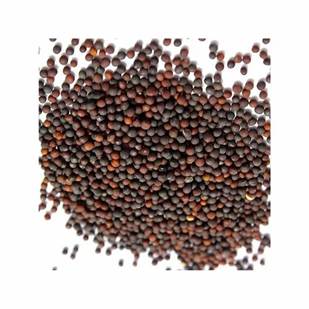
Before sowing, cabbage seeds should be treated to protect against seed-borne diseases and ensure healthy seedlings. Seeds are treated with Captan or Thiram @ 2–3 g per kg of seed. Alternatively, hot water treatment at 50°C for 30 minutes is also effective in controlling diseases like black rot. Treated seeds give better germination and healthy crop stand.
Manure
Farm Yard Manure (FYM)
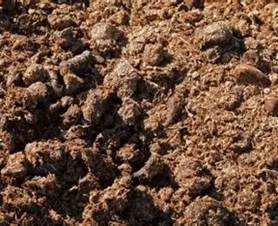
At the time of land preparation, well decomposed farm yard manure or compost @250 300 quintal per acre should be applied in the soil during field reparation and mixed well. It enhances organic matter content and naturally adds nitrogen to the soil, benefiting the succeeding the crop growth.
Fertilizer
Nutrient Requirement (kg per hectare)
| NITROGEN | PHOSPHORUS | POTASH |
| 150 kg | 60 – 80 kg | 80 kg |
Fertilizer Requirement (kg per hectare)
| UREA | SSP | MOP |
| 326 kg | 466 kg | 133 kg |
Note:
Half dose of Nitrogenous and full dose of Phosphatic and Potassium fertilizers should be applied at 5-7.5cm depth on both the sides of the line just before transplanting.
The remaining half dose of nitrogenous fertilizers is applied as top dressing in 2 to 3 split doses through broadcasting.
The foliar application of nitrogen at 10kg N/ha has been found economical and more effective in improving cabbage production.
Weed Control
Hoeing and weeding are done around 30 and 45 days after planting. Weed control can be effectively managed using pre-plant incorporation of herbicides such as Fluchloralin (0.75–1.5 kg/ha) or Pendimethalin (1.0 kg/ha), or through post-transplant application of Alachlor (1–2 kg/ha).
Nutrient Deficiency
Boron Deficiency
Boron deficiency in cabbage is a serious problem that affects both plant growth and head quality. The deficiency results in hollow stem, cracking of stems, and brown rot inside the curd, making the heads unfit for market and reducing yield. It also weakens cell wall development, which leads to poor firmness and storability of the curd.
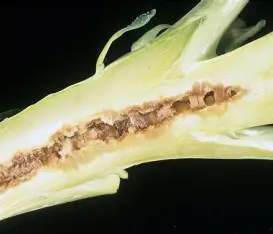
Management:
Boron deficiency can be managed by soil application of borax @ 10–15 kg/ha during land preparation. In standing crops, deficiency can be corrected by foliar spray of boric acid (0.25%) at regular intervals during growth to ensure proper curd formation and quality.
Molybdenum Deficiency
Molybdenum deficiency in cabbage is commonly seen in acidic soils and leads to a disorder called whiptail. In this condition, the leaves become narrow, deformed, and only the midrib develops, which affects photosynthesis and overall growth. The heads remain small and of poor quality, resulting in reduced market value.
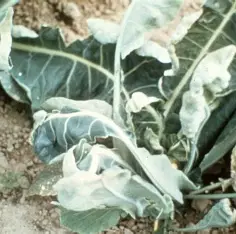
Management:
The deficiency can be corrected by applying sodium or ammonium molybdate @ 1–1.5 kg/ha to the soil. In addition, foliar sprays of 0.01% ammonium molybdate during the early growth stages are effective in preventing whiptail and ensuring healthy leaf and head development.
Irrigation
The first irrigation should be given immediately after transplanting the seedlings, followed by irrigation at 10–15 day intervals. However, it is most important to maintain adequate soil moisture during the critical stage of head formation and development. Irregular or uneven watering at this stage can cause the heads to split or burst, which reduces the quality of the crop.
Plant protection
Insect Pests and Their Control
| Pest/Insect | Symptoms | Peak Stage of Infestation | Management (with doses) |
| Cabbage Caterpillar | Green caterpillars feed on leaves, leaving veins and midribs exposed. | Seedling to head formation stage | Handpick larvae, spray Neem oil 5% @ 2–3 ml/litre water or Emamectin benzoate 5 SG @ 0.4 g/litre water. |
| Diamondback Moth | Small larvae scrape leaves, making irregular holes and skeletonizing them. | Throughout crop growth, esp. cool season | Use light traps, encourage natural enemies, spray Bt @ 1 g/litre or Spinosad 45 SC @ 0.3 ml/litre water. |
| Aphids | Colonies suck sap from leaves/shoots causing curling, yellowing, stunting, honeydew with sooty mold. | Cool season, mainly at head formation | Spray Neem oil 2–3% (20–30 ml/litre) or Imidacloprid 17.8 SL @ 0.3 ml/litre water. |
| Cabbage Head Borer | Larvae bore into heads and stems, damaging the edible portion. | Head formation stage | Destroy infested plants, spray Spinosad 45 SC @ 0.3 ml/litre or Emamectin benzoate 5 SG @ 0.4 g/litre water. |
| Cutworms | Cut seedlings at ground level during night feeding. | Early crop stage (nursery & after transplanting) | Apply poison bait (bran + jaggery + Chlorpyriphos 20 EC @ 2 ml/litre water), keep nursery weed-free. |
Cabbage Caterpillar
This is the most serious pest of cabbage. The caterpillars feed voraciously on leaves, leaving only veins and midribs, which reduces head formation.
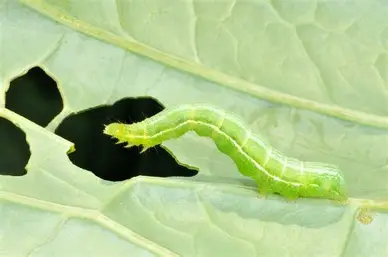
Management:
Handpick and destroy larvae in the early stage, spray Neem-based formulations (Neem oil 5%) or insecticides like Chlorpyriphos or Emamectin benzoate as recommended.
Diamondback Moth
Larvae of this moth scrape and feed on the leaf surface, causing irregular holes and reducing photosynthesis. Heavy infestations can cause severe yield loss. 
Management:
Use light traps to monitor, encourage natural enemies like parasitoid wasps, and spray Bt formulations or Spinosad for effective control.
Aphids
Aphids suck sap from tender shoots and leaves, leading to curling, yellowing, and stunted growth. They also secrete honeydew, which promotes sooty mold.
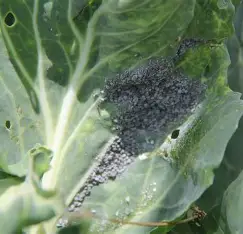
Management:
Spray neem oil (2–3%) or systemic insecticides like Imidacloprid or Thiamethoxam as per recommendation.
Cabbage Head Borer
The larvae bore into cabbage heads and stems, damaging the edible portion and making the crop unmarketable.
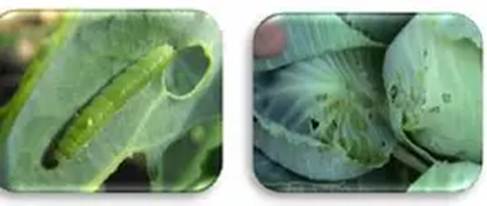
Management: Collect and destroy affected heads, and apply Emamectin benzoate or Spinosad sprays at early infestation stages
Cutworms
These pests cut seedlings at the ground level during night, causing serious losses in the early crop stage.
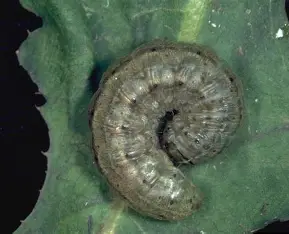
Management:
Apply poison baits (bran + jaggery + insecticide) around the field and keep the nursery free of weeds.
Diseases and their management
| Disease | Symptoms | Peak Stage of Infestation | Management (with doses) |
| Damping-off | Seedlings rot at base, collapse and die in nursery beds. | Nursery stage (before & after germination) | Treat seeds with Captan/Thiram @ 2–3 g/kg seed; drench nursery beds with Captan @ 2 g/litre water. |
| Black Rot | Yellowing at leaf margins, V-shaped lesions, veins turn black, rotting of heads. | All growth stages, especially humid weather | Use disease-free seed; hot water seed treatment (50°C for 30 min); spray Copper oxychloride 50 WP @ 2.5 g/litre water. |
| Downy Mildew | Yellow patches on upper leaf surface, white downy growth on underside. | Cool & humid conditions (nursery to field) | Spray Metalaxyl 8% + Mancozeb 64% WP @ 2 g/litre at 10–12 day intervals. |
| Club Root | Roots swell and become club-shaped, stunted growth, wilting in hot hours. | Field stage, especially in acidic soils | Maintain soil pH above 6.5 by lime application; follow crop rotation; use resistant varieties; drench soil with Carbendazim @ 2 g/litre if severe. |
| Alternaria Leaf Spot | Circular dark brown spots with concentric rings on leaves, reducing photosynthesis. | Cool, moist conditions during field stage | Spray Mancozeb 75 WP @ 2.5 g/litre or Chlorothalonil 75 WP @ 2 g/litre at 10–15 day intervals. |
1. Damping-off (Nursery Disease)
Symptoms:
This is a common disease in cabbage nurseries. The seeds fail to germinate properly, or young seedlings rot at the base. Infected seedlings topple over and die, leading to poor plant stand. It thrives in high soil moisture and dense sowing.
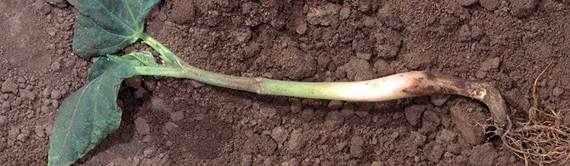
Management:
Seed treatment with Captan or Thiram @ 2–3 g/kg of seed helps prevent infection. Nursery beds should be drenched with Captan (2 g/litre water) and maintained with proper drainage to avoid excess moisture.
2. Black Rot
Symptoms:
Black rot is one of the most destructive bacterial diseases of cabbage. The earliest symptom is yellowing of leaf margins, which later form characteristic V-shaped yellow lesions pointing inward. The veins inside these lesions turn black, and in severe cases, the infection spreads to the heads, causing rotting and foul odour.
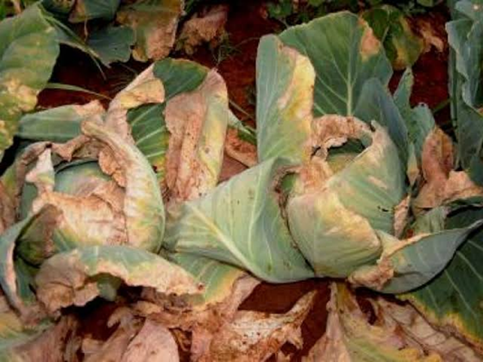
Management:
Use disease-free seeds and perform hot water treatment (50°C for 30 minutes) to kill pathogens. Crop rotation and destruction of infected residues are important. Preventive sprays of Copper oxychloride or Copper hydroxide help reduce the spread.
3. Downy Mildew
Symptoms:
This fungal disease appears as yellow irregular patches on the upper surface of leaves, while on the underside, a white to grey cottony growth is seen. Infected leaves become distorted and may drop prematurely, reducing plant vigour and yield. It is favoured by cool and humid conditions.
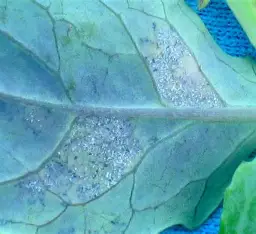
Management:
Regular spraying with Metalaxyl + Mancozeb at 10–12 day intervals helps control the disease. Avoid waterlogging and maintain proper spacing for aeration.
4. Club Root
Symptoms: Club root affects the roots of cabbage, which become swollen, malformed, and club-shaped. The plants show poor growth, remain stunted, and wilt during hot parts of the day even when soil moisture is adequate. This disease is particularly severe in acidic soils.
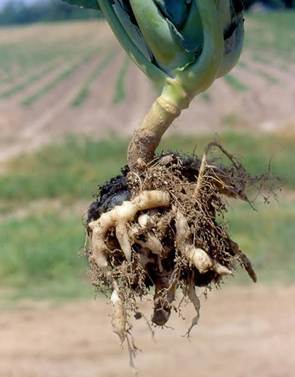
Management:
The disease can be minimized by maintaining soil pH above 6.5 through lime application. Practicing crop rotation with non-cruciferous crops and using resistant varieties also helps manage the problem.
5. Alternaria Leaf Spot
Symptoms:
Alternaria leaf spot causes circular, dark brown to black lesions with concentric rings on older leaves. These spots gradually enlarge, coalesce, and cause leaf blight. Severe infection reduces the photosynthetic area, leading to poor head formation.
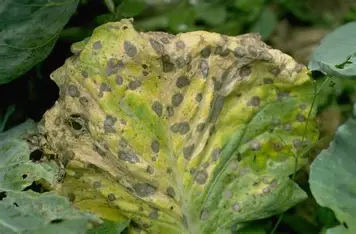
Management:
Spraying with Mancozeb or Chlorothalonil at regular intervals effectively controls the disease. Crop residues should be destroyed, and wide spacing should be maintained to reduce humidity in the field.
Harvest and post – Harvest Management
After harvesting, the outer mature unfolded leaves are removed, and if any long hard portion of stem is present, may also be removed. These heads are graded according to the size and quality and packed in gunny bags or plastic crates and transported to the markets in trucks. The marketable heads can be stored for 2-3 weeks if arranged in crates and placed in well ventilated place. They can be stored for several weeks in the Cold Storage at 00C to 1.70C with 85 to 87% relative humidity.
Sources