KRISHI SUVIDHA • AGRICULTURE NEWS
India’s Rice Surplus Raises Questions on Stocks, Subsidies and Crop Diversification
A Reuters investigation and FCI stock data highlight India’s expanding rice surplus, large central-pool inventories and the policy challenge of balancing farmer returns, food security, exports and sustainable crop diversification.
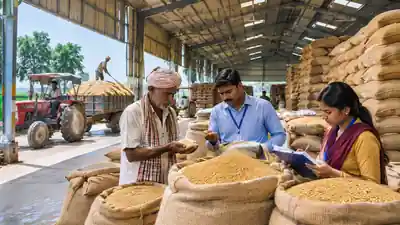
India’s rice sector is facing a major policy and market question: how should the country manage a large production surplus while protecting farm incomes, food security and natural resources? A Reuters investigation published on 18 November 2026 examines how crop science and long-running procurement support helped India become a leading rice producer and exporter—and why growing stocks and subsidy costs are prompting fresh debate.
Record production has changed India’s rice balance
Reuters reports that India’s rice output reached a record 154 million tonnes in 2025–26, around 50% higher than a decade earlier. It compares this with estimated domestic consumption of about 107 million tonnes. The report also says exports reached 22.3 million tonnes in 2025, giving India roughly 40% of global rice trade. These production, consumption and trade figures are attributed to Reuters and retain their respective crop-year and calendar-year references.
FCI data shows a substantial central-pool stock position
The Food Corporation of India’s stock statement, prepared on 11 November using Anna Darpan data, records 370.05 lakh metric tonnes of rice in the central pool as on 1 November 2026. It separately records 272.00 lakh tonnes of unmilled paddy with FCI and state agencies. At the stated 67% out-turn ratio, that paddy could yield an estimated 182.24 lakh tonnes of rice. The paddy-equivalent figure should not be mistaken for already milled rice.
For context, the official stocking norm for rice on 1 October is 102.50 lakh tonnes, comprising operational stock and strategic reserve. The 1 November milled-rice stock alone was therefore well above that benchmark. Stocks are not distributed evenly across regions, and movement, milling and procurement logistics matter as much as the national total.
Crop science and procurement helped drive the expansion
Reuters highlights the contribution of improved rice varieties, including flood-tolerant Swarna-Sub1, to more reliable production in flood-prone eastern states. Public procurement at the Minimum Support Price (MSP), together with additional state-level bonuses in some regions, has also strengthened the incentive to grow paddy. These factors have supported food availability and farm production, but can reinforce rice concentration where alternative crops and markets are less attractive.
Why the surplus is becoming a policy challenge
Large stocks can support the Public Distribution System, allow market intervention and provide a buffer against supply shocks. At the same time, high procurement, storage, handling and subsidy costs put pressure on public finances and warehouse capacity. Reuters reports a policy debate about whether incentives could better support pulses and oilseeds, for which India continues to rely on imports. The report describes official concerns and debate; it does not announce a new government decision to reduce MSP or stop rice procurement.
Water use and crop diversification need a careful transition
Rice cultivation can place substantial pressure on groundwater where irrigation depends on pumping. A shift towards pulses, oilseeds or other locally suitable crops may help diversify production and reduce resource stress, but requires reliable seed, extension support, procurement or market access, processing facilities and income protection. Farmers should not change crop plans solely on the basis of a national surplus headline.
What farmers, FPOs and policymakers should watch
• Track state-wise procurement arrangements, MSP operations and local mandi prices before making marketing decisions.
• Assess water availability, soil conditions, crop duration and local market demand before considering pulses or oilseeds.
• FPOs and millers should monitor storage capacity, milling schedules, quality specifications and transport availability.
• Policy planning needs to balance food security and farmer price support with storage costs, export competitiveness and sustainable water use.
The central issue is not whether India should produce less rice overnight. It is how to align crop incentives, technology, procurement and market infrastructure so farmers retain dependable returns while the country builds a more balanced and resource-efficient crop mix. Farmers should follow their State Agriculture Department, KVK and local procurement agencies for location-specific decisions.
Sources and further reading
• Reuters, 18 November 2026: How India became a rice powerhouse—and why it is becoming a problem
• FCI / Department of Food and Public Distribution: Central-pool stock position as on 1 November 2026 (prepared 11 November)
• Related reading: India–EU GI-tag discussions and Basmati rice
Editorial note: Production, consumption and export figures are attributed to Reuters. FCI stock figures are from the official central-pool statement. This article explains a reported policy debate; it does not present it as a newly notified government policy.