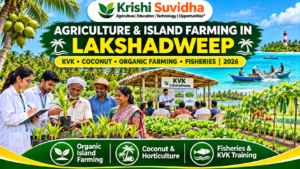
Agriculture, Coconut Farming, Research and KVK in Lakshadweep
Explore the island’s organic farming model, ICAR-KVK Lakshadweep, coconut and horticulture development, marine fisheries, farmer organisations and learning opportunities.
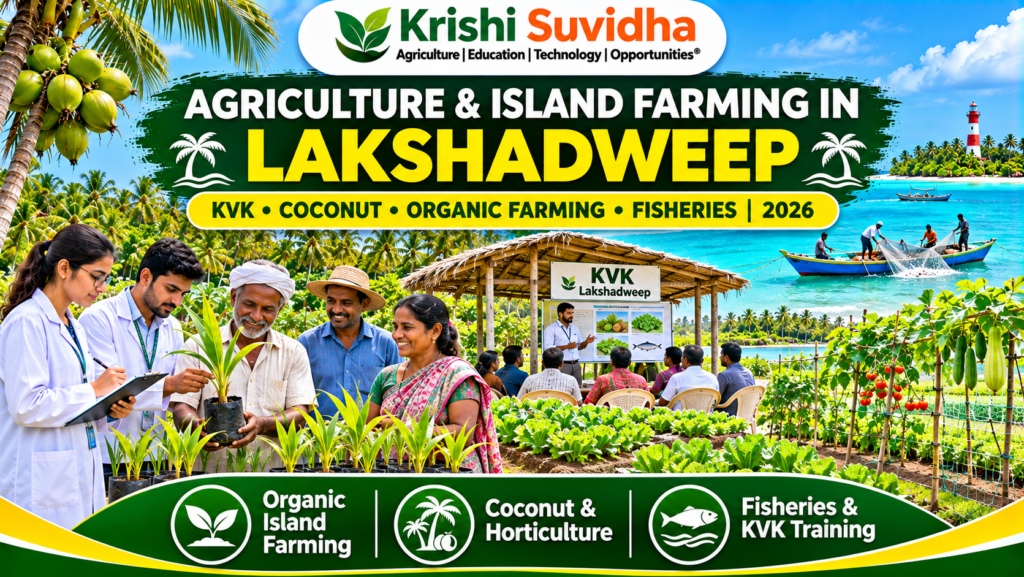
Lakshadweep’s agriculture is shaped by its coral-island ecology, limited cultivable land, saline surroundings and dependence on coconut-based farming, household vegetable gardens and marine livelihoods. Rather than a conventional large-scale field-crop system, the islands’ agriculture focuses on coconut, backyard nutrition gardens, organic cultivation, soil and water conservation, and sustainable use of local resources. The Union Territory has a dedicated Krishi Vigyan Kendra (KVK) at Kavaratti, administered by ICAR-Central Marine Fisheries Research Institute (CMFRI), along with the Agriculture and Fisheries Departments of the Lakshadweep Administration.
1. ICAR–Krishi Vigyan Kendra (KVK), Lakshadweep
KVK Lakshadweep – hosted by ICAR-CMFRI
KVK Lakshadweep was established in 1999 and is situated at Kavaratti, the capital of the Union Territory. Its official institutional profile states that the KVK is hosted by ICAR-Central Marine Fisheries Research Institute (CMFRI), Kochi, and its operational activities cover the ten inhabited islands. The KVK works under approved action plans and is part of India’s national agricultural extension system.
Core mandate: Assess and demonstrate location-specific technologies, conduct vocational training, undertake on-farm testing and frontline demonstrations, provide technical guidance and strengthen the capacity of farmers, farm women, rural youth and extension personnel.
Key areas of work:
- Coconut-based farming: improved coconut cultivation, nursery development, planting material, palm management, pest and disease management and value addition.
- Organic and backyard agriculture: organic cultivation, household nutrition gardens, vegetable production, composting, biomass recycling and low-input farming.
- Horticulture: tropical fruits, vegetables, nursery raising, planting material and cultivation practices suited to small island holdings.
- Fisheries and allied livelihoods: marine fisheries awareness, ornamental fisheries, aquaculture-related demonstrations and livelihood diversification in collaboration with ICAR-CMFRI and relevant departments.
- Farmer institutions and enterprise: capacity building for farmer groups, self-help groups, cooperatives and Farmer Producer Organisations (FPOs), including post-harvest handling and market connections.
Notable extension work: KVK and partner institutions have supported the Kavaratti Island Coconut Farmers Producer Cooperative Society and a coconut nursery initiative, including work with ICAR-Central Plantation Crops Research Institute (CPCRI). KVK also supports island-level training and technology dissemination.
Research and learning opportunities: Students may explore field visits, extension exposure, approved internships or project interactions when available. KVK is not a degree-awarding institution; training certificates do not replace a university degree.
Address: ICAR-KVK Lakshadweep, Kavaratti P.O., Lakshadweep – 682555. Phone: 04896-263710. Email: kvklashadweep@gmail.com.
KVK Lakshadweep – official website · Establishment, host organisation and mandate
2. Department of Agriculture, Lakshadweep Administration
Directorate of Agriculture
The Department of Agriculture was established in 1956 and is one of the oldest departments of the Lakshadweep Administration. It supports island farming through technical advice, seeds and planting material, fertilisers and equipment, coconut development, household nutrition gardens, plant protection and farmer training.
Important programmes and services described on the official portal:
- Nutri Garden: Encourages terrace and backyard cultivation of vegetables and fruits through the supply of inputs such as seeds and seedlings, including tomato, brinjal, chilli, sapota, mango and guava.
- Coconut Development Programme: Supports coconut cultivation through inputs such as copra dryers, suitable dwarf coconut varieties, palm health interventions and support related to coconut climbers.
- Integrated pest and disease management: Provides support to manage pests and diseases affecting coconut and other locally important plants.
- Human resource development: Conducts training programmes for farming communities and technical personnel.
- Central sector schemes: Implements or facilitates schemes including PM-KISAN, Kisan Credit Card and horticulture development programmes, subject to current eligibility and guidelines.
Contact: Directorate of Agriculture, Kavaratti – 682555. Phone: 04896-262012. Refer to the official portal for current email and service details.
Lakshadweep Agriculture Department – official profile and services
3. ICAR-Central Marine Fisheries Research Institute (CMFRI) and fisheries research support
ICAR-CMFRI and its Kavaratti field presence
ICAR-CMFRI is the host organisation for KVK Lakshadweep. Its work is important to the islands because marine resources, tuna fisheries, reef-associated biodiversity and lagoon ecosystems are central to local livelihoods and food systems. The KVK and CMFRI collaborate on technology demonstrations, capacity building and fisheries-based livelihood initiatives.
Relevant areas: marine fisheries resource management, sustainable fishing, mariculture, marine ornamental fisheries, aquaculture technologies, fish health, post-harvest handling, seafood quality, value addition and fisheries entrepreneurship.
Recent technology and enterprise initiatives: ICAR reported in August 2026 that CMFRI’s Kochi Field Laboratory in Kavaratti and KVK Lakshadweep supported marine ornamental fisheries inputs at Agatti. The initiative aimed to encourage sustainable ornamental aquaculture and livelihood diversification. ICAR also reported development of a recirculating aquaculture system (RAS)-based marine ornamental fish hatchery at Kavaratti.
Student relevance: Fisheries science, marine biology, aquaculture, coastal resource management and seafood technology students may monitor CMFRI notices for research, training and field exposure opportunities. These opportunities are not the same as local undergraduate degree admissions.
ICAR-CMFRI – official website · ICAR update on ornamental fisheries support in Lakshadweep, 2026
4. Coconut research and technology support: ICAR-CPCRI
ICAR–Central Plantation Crops Research Institute (CPCRI)
ICAR-CPCRI, headquartered at Kasaragod in Kerala, is a key national research institution for coconut, arecanut and other plantation crops. It has provided technical and research support for coconut development in Lakshadweep, including collaboration with KVK and the Agriculture Department. Its work is relevant to improving coconut planting material, crop management, pest and disease control, production systems and product diversification.
Areas relevant to island farmers: coconut varieties and hybrids, nursery management, integrated nutrient and pest management, intercropping, coconut-based farming systems, post-harvest processing and value-added products.
Important location note: CPCRI is not a college located in Lakshadweep. It is a mainland ICAR research institute whose technologies and expertise can support island coconut farmers through institutional collaboration.
5. Department of Fisheries, Lakshadweep Administration
Directorate of Fisheries
The Fisheries Department was established in 1959 and supports fisheries development across the inhabited islands. Tuna is a major fishery resource, and pole-and-line fishing is a distinctive traditional method in Lakshadweep. The department’s official profile describes initiatives for sustainable fishing, infrastructure, processing, cold storage, seaweed farming, fisher safety and livelihood diversification.
Key areas and initiatives:
- Responsible tuna fisheries and support for traditional fishing practices.
- Fisheries infrastructure, cold-chain facilities, processing and value addition.
- Seaweed farming demonstrations and development of a seaweed cluster.
- Fisheries cooperatives, Kisan Credit Cards and support for small fisheries enterprises.
- Technology-enabled Potential Fishing Zone advisories and ocean-state information for safer and more efficient fishing.
- Climate-resilient coastal fishing communities and fisheries livelihood projects.
Lakshadweep Fisheries Department – official profile and services
6. Agriculture and allied-sector institutions: quick comparison
| Institution | Location | Primary role | Degree-awarding status |
|---|---|---|---|
| ICAR-KVK Lakshadweep | Kavaratti | Farmer training, demonstrations, technology assessment and extension across inhabited islands | Not degree-awarding |
| Department of Agriculture | Kavaratti; services across UT | Coconut, nutrition gardens, inputs, schemes and farmer support | Government department; not a college |
| ICAR-CMFRI | Headquarters Kochi; field activities in Lakshadweep | Marine fisheries research, mariculture and fisheries technology | Research institute; not a local agricultural college |
| ICAR-CPCRI | Kasaragod, Kerala | Coconut and plantation-crop research and technology support | Research institute outside Lakshadweep |
| Department of Fisheries | Kavaratti; services across UT | Fisheries development, infrastructure, cooperatives and livelihood support | Government department; not a college |
7. Is Lakshadweep an organic farming territory?
ICAR’s published account describes Lakshadweep as a community-led organic agriculture success story. It reports that island communities voluntarily avoided chemical fertilisers and pesticides from 2005 to protect limited land resources, lagoons and coral reefs. A structured Participatory Guarantee System (PGS-India) certification process was subsequently supported by the UT Administration and KVK. ICAR reports that by 2024, 8,126 farmers were registered on the PGS portal and the entire cultivable area had been brought under Large Area Certification.
The island model is based on coconut-oriented farming, household vegetable cultivation, low external input use and recycling of biomass. Formal certification status and renewal details can change; farmers and buyers should verify the current certificate, scope, validity and traceability arrangements before making a product-level organic claim.
ICAR – Lakshadweep: India’s Organic Islands
8. Are there agriculture colleges or private agricultural universities in Lakshadweep?
In the official sources reviewed for this guide, we could not verify a private agricultural university or local private college offering a recognised B.Sc. (Hons.) Agriculture, B.Sc. Horticulture or equivalent professional agriculture degree in Lakshadweep. The documented local system is centred on KVK Lakshadweep, the UT Agriculture and Fisheries Departments, and mainland ICAR research organisations providing technical support.
9. Where can students from Lakshadweep study agriculture and allied sciences?
Students seeking recognised professional degrees can explore established agricultural, fisheries and allied-science universities on the mainland. These institutions are not located in Lakshadweep. Check current prospectuses for eligibility, entrance route, domicile and reservation rules, seats, fees and hostel availability.
Kerala Agricultural University (KAU)
Offers agriculture, horticulture and allied academic programmes through its colleges and research network. Students should check the current programme list and admission process.
Kerala University of Fisheries and Ocean Studies (KUFOS)
A specialist university for fisheries and ocean studies, relevant to fisheries science, aquaculture, marine science and allied fields. Review the current prospectus for programme availability.
ICAR-CPCRI
A research institute rather than an undergraduate college. It is relevant for coconut and plantation crop research, training and approved research collaboration.
ICAR-CMFRI
A national marine fisheries research institute. Students may explore research and training notices in marine fisheries, mariculture and post-harvest technology; degree admissions are through recognised universities.
10. Training, farmer support and career pathways
- Farmers and farm women: Contact KVK Lakshadweep for the current training calendar on coconut cultivation, backyard nutrition gardens, organic practices, plant protection, value addition and allied enterprises.
- Fisherfolk and fisheries entrepreneurs: Contact the Fisheries Department and KVK for current schemes, training, sustainable fisheries initiatives and technology demonstrations.
- Students: Monitor university and ICAR institute announcements for formal admissions, internships, dissertation projects and approved field training.
- Entrepreneurs and FPOs: Explore coconut nurseries, copra and coconut products, food processing, fish processing, ornamental fisheries, seaweed-related activities and local market linkages, subject to applicable permissions and scheme conditions.
Coconut and plantation crops
Nursery enterprises, improved planting material, coconut-based intercropping, copra processing, value-added products and farmer cooperatives.
Organic and nutrition gardens
Backyard vegetables, composting, biomass recycling, organic production, household nutrition and local seed/seedling systems.
Fisheries and blue economy
Tuna value chains, ornamental fisheries, seaweed farming, fish processing, cold chain and sustainable marine resource management.
Research and rural enterprise
Climate resilience, island biodiversity, extension services, FPO development, agri-food entrepreneurship and livelihood diversification.
11. Official sources and useful links
- ICAR-KVK Lakshadweep – official website.
- KVK Lakshadweep – establishment, host organisation and mandate.
- ICAR – official KVK directory entry for Lakshadweep.
- Lakshadweep Administration – Department of Agriculture.
- Lakshadweep Administration – Department of Fisheries.
- ICAR-Central Marine Fisheries Research Institute.
- ICAR-Central Plantation Crops Research Institute.
- ICAR – Lakshadweep organic islands case study.
- ICAR – 2026 marine ornamental fisheries initiative.
- ICAR – list of agricultural universities.
Explore agriculture education in other states and UTs
Continue with our guides to Andaman & Nicobar Islands, Puducherry, Chandigarh, Delhi, Ladakh, Jammu & Kashmir, Kerala, Tamil Nadu and our national agriculture college directory.
Explore island farming and agricultural support in Lakshadweep
For farmer training and technology demonstrations, contact ICAR-KVK Lakshadweep at Kavaratti. For crop inputs and coconut development services, consult the Agriculture Department. For marine fisheries support, contact the Fisheries Department and ICAR-CMFRI.
KVK Lakshadweep · Agriculture Department · Fisheries Department
Editorial note: Lakshadweep is a Union Territory. KVK Lakshadweep is an extension and training centre, not a degree-awarding college. ICAR-CMFRI and ICAR-CPCRI are research institutions based on the mainland with work and technical support relevant to the islands. This article is an institutional and education guide, not a ranking or admission notification. Verify current scheme rules, organic certification validity, training schedules and course details with official authorities before making decisions.