Agriculture Education, Colleges and Research Institutions in Ladakh
Explore the University of Ladakh’s School of Agriculture Science & Technology, high-altitude agricultural research, ICAR-supported KVKs, cold-desert farming and education pathways.
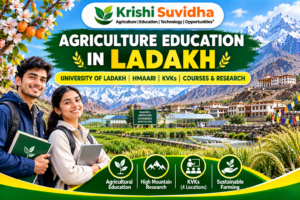
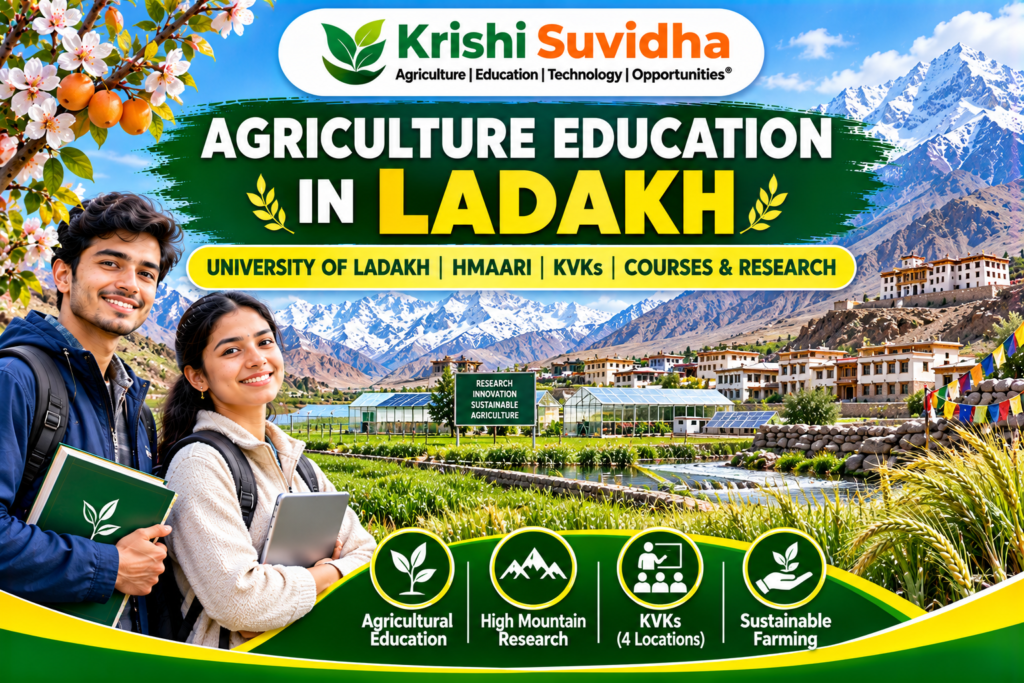
Ladakh’s high-altitude cold-desert environment creates specialised needs in agriculture education, research and farmer training. The region’s academic and extension ecosystem includes the School of Agriculture Science & Technology (SAST), University of Ladakh, the High Mountain Arid Agriculture Research Institute (HMAARI), Stakna, the ICAR-Central Arid Zone Research Institute (CAZRI), Regional Research Station, Leh, and four Krishi Vigyan Kendras (KVKs) serving Leh and Kargil. These organisations contribute to research, technology demonstration, skill development and climate-resilient agriculture.
1. School of Agriculture Science & Technology (SAST), University of Ladakh
University of Ladakh – School of Agriculture Science & Technology
The School of Agriculture Science & Technology is located at Stakna village, approximately 30 km from Leh town, according to a University of Ladakh institutional brochure. The school has its roots in the High Mountain Arid Agriculture Research Institute (HMAARI), formerly associated with SKUAST-Kashmir. The research station’s origins trace to the Regional Agricultural Research Station established at Leh in 1989. Research activities were consolidated at the Stakna farm, which became a key centre for agricultural research and outreach in the cold-desert region.
Academic and research focus: High-altitude agriculture, sustainable crop production, agronomy, horticulture, fruit and fodder crops, exotic vegetables, natural-resource management, climate-resilient technologies and farmer-oriented demonstrations.
Education pathway: The School of Agriculture Science & Technology is an academic and research unit within the University of Ladakh. Prospective students should consult the University’s current prospectus and department notices to determine which degree, certificate, elective or research programmes are open in the current session. Do not assume that a KVK training course or research facility is equivalent to a B.Sc. Agriculture degree.
Who may find it relevant: Students and researchers interested in cold-arid agriculture, high-altitude crop systems, sustainable livelihoods, climate adaptation, mountain horticulture and agricultural innovation.
University of Ladakh – official website · University agriculture and KVK information
2. High Mountain Arid Agriculture Research Institute (HMAARI), Stakna
HMAARI – High Mountain Arid Agriculture Research Institute
HMAARI has been an important centre for research and extension in Ladakh’s cold-arid agro-ecosystem. The institute was historically associated with SKUAST-Kashmir; institutional material from the University of Ladakh describes its integration into the University’s School of Agriculture Science & Technology following the creation of the Union Territory. The District Leh directory continues to list HMAARI at Stakna and provides institutional contact details.
Research themes: Crop adaptation under high-altitude conditions, short growing seasons, water-use efficiency, soil health, protected cultivation, vegetable and fodder production, fruit crops, climate-resilient farming and location-specific agronomic practices.
Research and learning opportunities: Students and researchers may explore field exposure, project collaboration, demonstrations and technical interaction through official University of Ladakh channels. Availability of internships, project positions or formal academic supervision must be confirmed directly with the institute.
District Leh – SKUAST/HMAARI directory · University of Ladakh
3. ICAR-Central Arid Zone Research Institute (CAZRI), Regional Research Station, Leh
CAZRI – Regional Research Station, Leh
The ICAR-Central Arid Zone Research Institute’s Regional Research Station at Leh undertakes research relevant to cold-arid farming systems and natural resources. Its published thrust areas include development of area-specific farming practices for cold-arid regions and maintaining information on natural resources and desertification.
Research disciplines and activities: The station lists agronomy as a discipline and describes work on weed management in onion, wheat and potato; evaluation of crop accessions for adaptation to cold-arid conditions; sea buckthorn potential for soil productivity and nutritional value; soil-resource assessment; phytoremediation; demonstrations of proven technologies; and farmer awareness on sustainable production and climate change.
Relevance to students: The station is a useful research and technical resource for understanding dryland agronomy, crop adaptation, natural-resource management and sustainable production. It is a research station, not a degree-awarding college.
4. Krishi Vigyan Kendras (KVKs) serving Ladakh
KVKs provide farmer-facing vocational training, on-farm testing, frontline demonstrations, technology dissemination and capacity building. They are not degree-awarding colleges. ICAR’s 24 March 2026 announcement records an MoU with the University of Ladakh to host four KVKs serving Leh-I, Leh-II (Nyoma), Kargil-I and Kargil-II (Zanskar). ICAR states that these KVKs were earlier under the administrative control of SKUAST-Kashmir.
KVK Leh-I
Located in the Leh area and serving farmers through agricultural extension, training and demonstrations. The KVK’s published material identifies its historic establishment in 1994.
KVK Leh-II (Nyoma)
Supports agricultural and allied livelihood activities in the Nyoma/Changthang region, where high-altitude conditions require specialised production and extension practices.
KVK Kargil-I
Provides local farmer training and technology transfer for crops and allied activities in Kargil district. Contact the KVK for current training calendars and demonstrations.
KVK Kargil-II (Zanskar)
Serves the Zanskar region through location-specific agricultural extension, capacity building and dissemination of suitable technologies.
Quick comparison of Ladakh’s agriculture institutions
| Institution | Location | Primary role | Degree-awarding status |
|---|---|---|---|
| School of Agriculture Science & Technology, University of Ladakh | Stakna, Leh | Higher education, research and academic activities in agriculture science | Part of University of Ladakh; verify current programme offerings in prospectus |
| HMAARI | Stakna, Leh | High-mountain arid agriculture research and outreach | Research institute/unit; not a separate university |
| ICAR-CAZRI Regional Research Station | Leh | Cold-arid agronomy, natural resources and sustainable farming research | Research station; not a degree-awarding college |
| Four KVKs | Leh-I, Nyoma, Kargil-I, Zanskar | Farmer training, demonstrations and extension | Not degree-awarding colleges |
Are there private agriculture colleges or universities in Ladakh?
We could not verify a private university or private college in Ladakh offering a recognised B.Sc. (Hons.) Agriculture, B.Sc. Horticulture or equivalent professional agriculture degree in the official sources reviewed for this guide. Ladakh’s documented agriculture education and extension ecosystem is centred on the University of Ladakh, research institutions and ICAR-supported KVKs. Students should be cautious about advertisements claiming a local private agriculture degree without verifiable affiliation and programme approval.
What can students study for a career in Ladakh’s agriculture sector?
Where a suitable local degree programme is not listed for the current session, students may consider recognised agriculture and allied-science universities elsewhere in India for undergraduate study, then explore Ladakh-specific research, internships, field projects or employment opportunities. Relevant degree areas include:
Agriculture and Agronomy
Crop science, soil science, agronomy, plant breeding, plant protection, agricultural extension and dryland farming.
Horticulture
Temperate fruits, apricot and other orchard crops, vegetable science, protected cultivation, nursery management and post-harvest handling.
Natural Resources
Soil and water conservation, irrigation efficiency, watershed management, rangelands, biodiversity and climate adaptation.
Allied and emerging fields
Animal science, dairy, food processing, agricultural engineering, renewable-energy applications and agri-entrepreneurship.
Admission, training and research opportunities
- University of Ladakh: Check the latest prospectus and School of Agriculture Science & Technology notices for active programmes, eligibility, application dates, fees and campus details.
- SKUAST-K and other agricultural universities: Students seeking a recognised B.Sc. Agriculture or allied degree should check the current admission prospectuses of ICAR-listed agricultural universities and the applicable entrance/counselling route.
- KVK training: Contact the relevant KVK for farmer-oriented vocational training, demonstrations, exposure visits and scheduled capacity-building programmes. These are generally non-degree activities.
- Research exposure: Ask HMAARI, CAZRI and the University of Ladakh about current projects, internships, dissertation collaboration and field research opportunities. Availability is not guaranteed and must be confirmed with the institution.
- Scholarships and residence: Review current University of Ladakh and destination-university notices for scholarships, hostel facilities, domicile rules and category provisions.
Why agricultural research matters in Ladakh
Ladakh’s short growing season, low precipitation, high altitude, cold winters and fragile mountain ecosystems call for locally adapted technologies. Research on protected cultivation, water-efficient irrigation, soil fertility, hardy crop varieties, fruit and fodder systems, post-harvest management and climate adaptation can help strengthen food and livelihood security. The University of Ladakh–ICAR KVK collaboration announced in March 2026 is intended to reinforce technology dissemination, farmer capacity building and climate-resilient agriculture across the UT.
Official sources and useful links
- University of Ladakh – official website.
- University of Ladakh – agriculture/KVK information.
- ICAR – 24 March 2026 announcement on four KVKs and University of Ladakh collaboration.
- ICAR – KVK directory for Ladakh.
- ICAR-CAZRI – Regional Research Station, Leh.
- District Leh – SKUAST/HMAARI contact directory.
- ICAR – list of agricultural universities.
- Ladakh Administration – Higher Education Department.
Explore agriculture colleges in other states and UTs
Continue with our guides to Jammu & Kashmir, Andhra Pradesh, Arunachal Pradesh, Assam, Bihar, Chhattisgarh, Goa, Gujarat, Haryana, Himachal Pradesh, Jharkhand, Karnataka, Kerala, Madhya Pradesh, Maharashtra, Manipur, Meghalaya, Mizoram, Nagaland, Odisha, Punjab, Rajasthan, Sikkim, Tamil Nadu, Telangana, Tripura, Uttar Pradesh, Uttarakhand and West Bengal. See also our national agriculture college directory.
Explore agriculture education and research in Ladakh
For formal degree admissions, confirm current programmes with the University of Ladakh. For farmer training and field demonstrations, contact the relevant KVK. For cold-arid research, explore HMAARI and ICAR-CAZRI.
Editorial note: Ladakh is a Union Territory. This article is an education and institutional guide, not a ranking or admission notification. Research institutes and KVKs are not degree-awarding colleges. Programme availability, affiliation, administrative arrangements and training schedules may change; verify details with the relevant institution before applying or enrolling.